Gas Insulated Substation (GIS)
A Gas Insulated Substation (GIS) is a compact and highly reliable substation technology widely used in modern power systems, especially in urban areas where space is limited. Instead of air insulation, GIS uses SF6, (Sulfur hexafluoride)gas to provide excellent insulation and arc-quenching capability, allowing high-voltage equipment to be installed in a much smaller footprint.
Key Components of a GIS System
Bus Bar (BUS)
Main current-carrying conductor inside the GIS
Interconnects different bays such as incomers, feeders, and transformers
Fully enclosed in SF6, gas for insulation and protection
Circuit Breaker (CB)
Interrupts both load current and fault current
Operates automatically during short circuits or protection trips
Uses SF6,gas for effective arc quenching
Disconnect Switch (DS)
Provides visible isolation of equipment Operated only under no-load conditions
Essential for safe maintenance procedures
Current Transformer (CT)
Measures line current
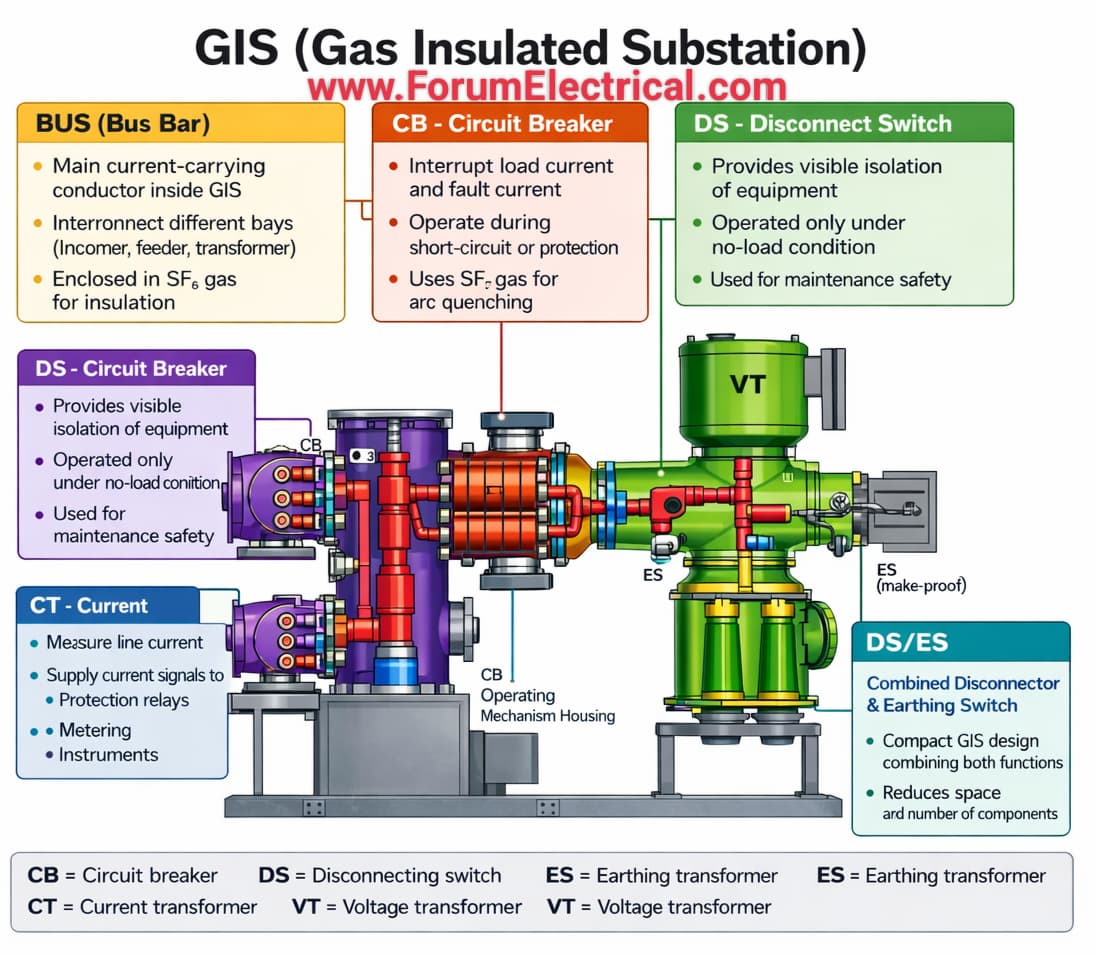
Provides signals to protection relays and metering systems
Critical for system protection and monitoring
Voltage Transformer (VT)
Step down high voltage to safe, measurable values
Used for protection, metering, and control circuits
Combined Disconnector & Earthing Switch (DS/ES)
Integrates isolating and earthing functions
Enhances safety during maintenance
Reduces equipment size and component count in GIS design
Why GIS?
Compact design-ideal for space-constrained locations
High reliability and safety
Reduced maintenance requirements
Protection against environmental conditions
•GIS technology is playing a crucial role in modern high-voltage transmission systems, particularly in 132kV,220kV,380kV, and higher voltage substations, where reliability and space optimization are critical.