Explain the working of PID controller in detail?
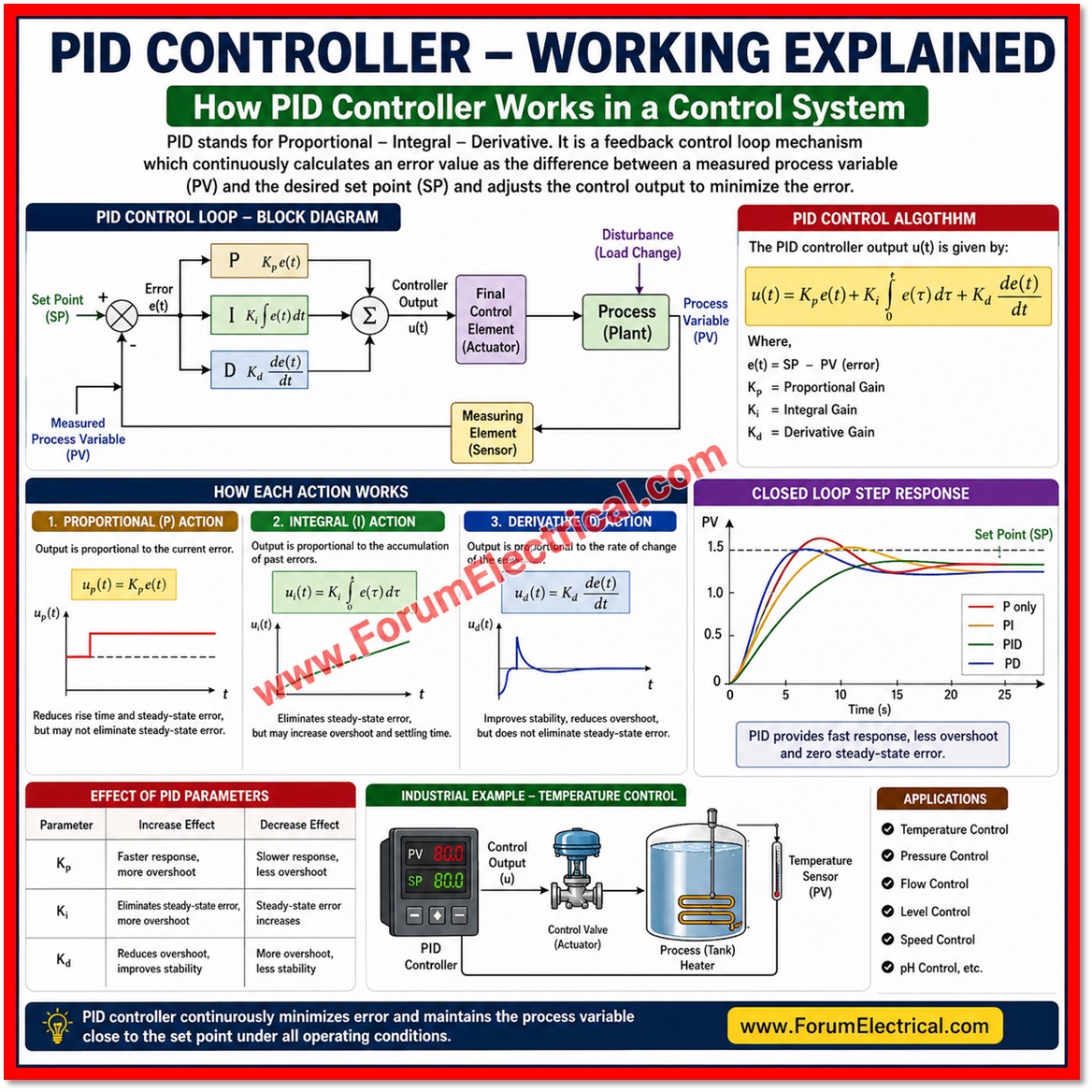
Reference Image Provided by the Respondent
A PID (Proportional–Integral–Derivative) controller is a widely used control system that automatically maintains a process variable such as temperature, pressure, flow, speed, or level at a desired setpoint. It continuously compares the actual process value with the setpoint and calculates a corrective output to minimize the error.
A PID controller works by calculating the difference between the setpoint (SP) and the process variable (PV):
Error = Setpoint − Process Variable
Based on this error, the controller produces an output using three control actions: Proportional (P), Integral (I), and Derivative (D).
The Proportional term produces an output proportional to the present error. If the error increases, the controller increases its output accordingly.
For example, if a temperature setpoint is 100°C and the actual temperature is 90°C, the 10°C error causes the controller to increase the heating output.
A higher proportional gain can make the system respond faster, but excessive gain may cause oscillation or instability.
The Integral term responds to the accumulated error over time. Its main purpose is to eliminate steady-state error.
For example, if the temperature remains slightly below the setpoint for a long period, the integral action gradually increases the controller output until the error is reduced toward zero.
However, excessive integral action can cause overshoot and oscillations.
The Derivative term responds to the rate at which the error is changing. It helps predict the future behavior of the process and can reduce overshoot.
If the process variable is approaching the setpoint very rapidly, derivative action can reduce the controller output before the setpoint is exceeded.
Because derivative action is sensitive to measurement noise, it is often filtered or used carefully in practical systems.
The three control actions are combined to calculate the final controller output:
PID Output = Proportional Action + Integral Action + Derivative Action
The mathematical form is:
u(t) = Kp e(t) + Ki ∫e(t)dt + Kd de(t)/dt
Where:
The basic control sequence is:
Setpoint → Compare with Process Variable → Calculate Error → PID Calculation → Control Output → Final Control Element → Process → Feedback
For example, in a temperature control system, the PID controller receives the desired temperature and the actual temperature from a sensor. It calculates the error and adjusts the heater output continuously to maintain the required temperature.
PID controllers are commonly used in:
PID control provides accurate, stable, and automatic process control without requiring continuous manual adjustment. Properly tuned P, I, and D parameters allow the system to achieve fast response, minimum overshoot, reduced steady-state error, and improved process stability.