Essential Protection Settings of Air Circuit Breaker (ACB)
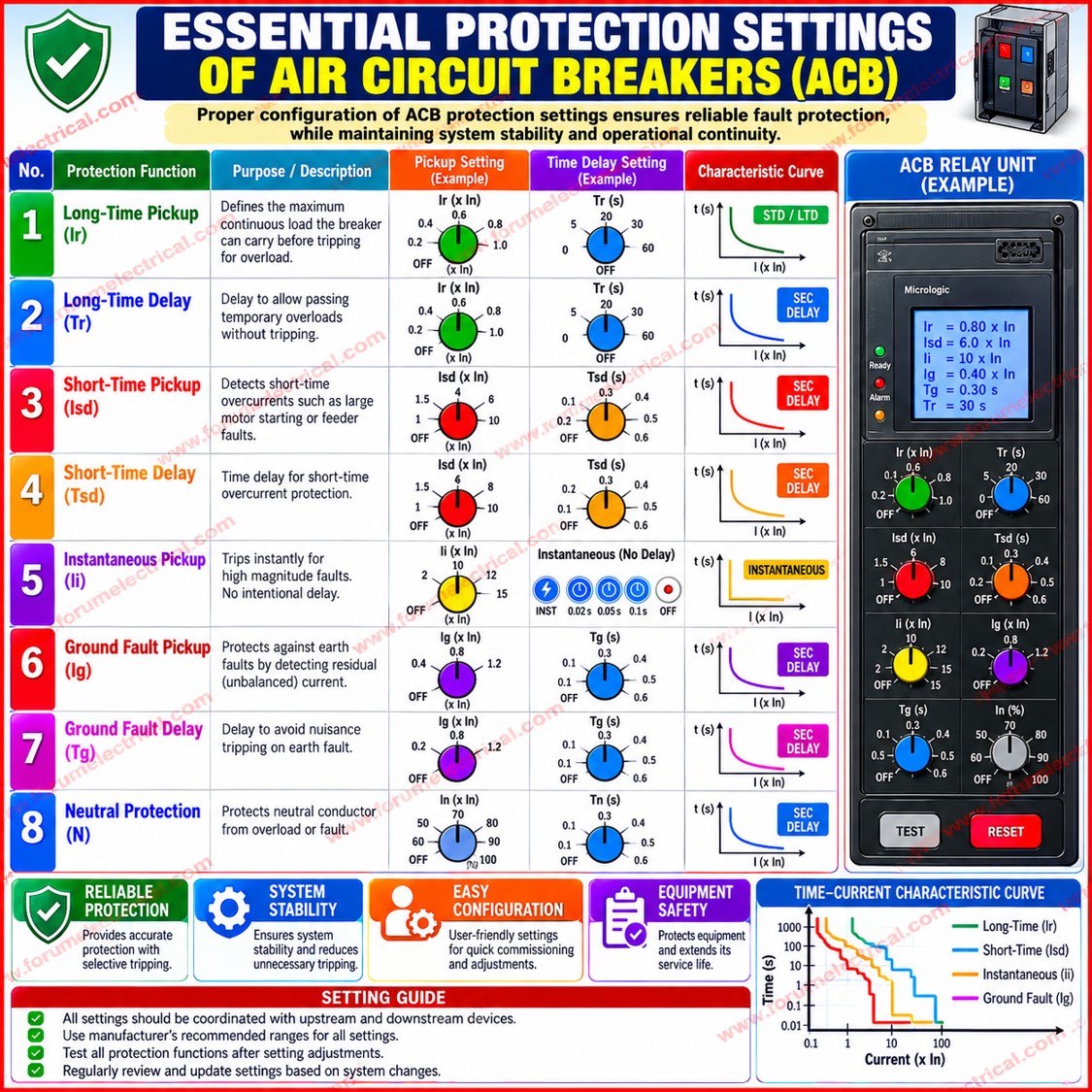
An Air Circuit Breaker (ACB) is a critical protection device in low-voltage power distribution systems. Proper protection settings help ensure reliable fault clearance, selective coordination, and equipment safety.
Important ACB Protection Settings
-
Long-Time Pickup (Ir): Protects against overload conditions.
-
Long-Time Delay (Tr): Allows temporary overloads without unnecessary tripping.
-
Short-Time Pickup (Isd): Detects high overcurrents and short-circuit faults.
-
Short-Time Delay (Tsd): Supports coordination with downstream protective devices.
-
Instantaneous Pickup (Ii): Provides rapid tripping during severe short circuits.
-
Ground Fault Pickup (Ig): Detects earth faults when ground-fault protection is provided.
-
Ground Fault Delay (Tg): Helps coordinate ground-fault protection.
-
Neutral Protection: Protects the neutral conductor against excessive current, where applicable.
Why Proper ACB Settings are Important?
-
Prevent equipment damage
-
Reduce unnecessary tripping
-
Improve system reliability
-
Ensure selective protection coordination
-
Enhance electrical safety and operational continuity
Always determine ACB protection settings through a proper protection coordination study.
Consider load current, cable ampacity, transformer capacity, available fault current, earthing arrangements, and manufacturer recommendations.
Incorrect settings may cause nuisance tripping or prevent faults from being cleared safely.