Electrical Circuit Breakers – Types and Functions
Understanding different types of circuit breakers is essential for electrical engineers, technicians, and maintenance professionals.
Each breaker is designed to provide specific protection based on the electrical system and application.
1). MCB – Miniature Circuit Breaker
2). MCCB – Molded Case Circuit Breaker
3). RCCB – Residual Current Circuit Breaker
4). RCCD – Residual Current Circuit Device
5). ELCB – Earth Leakage Circuit Breaker
7). VCB – Vacuum Circuit Breaker
8). DCCB – DC Circuit Breaker
9). RCBO – Residual Current Breaker with Overcurrent Protection
10). MPCB – Motor Protection Circuit Breaker
11). AFCB – Arc-Fault Circuit Breaker
12). GFCB – Ground-Fault Circuit Breaker
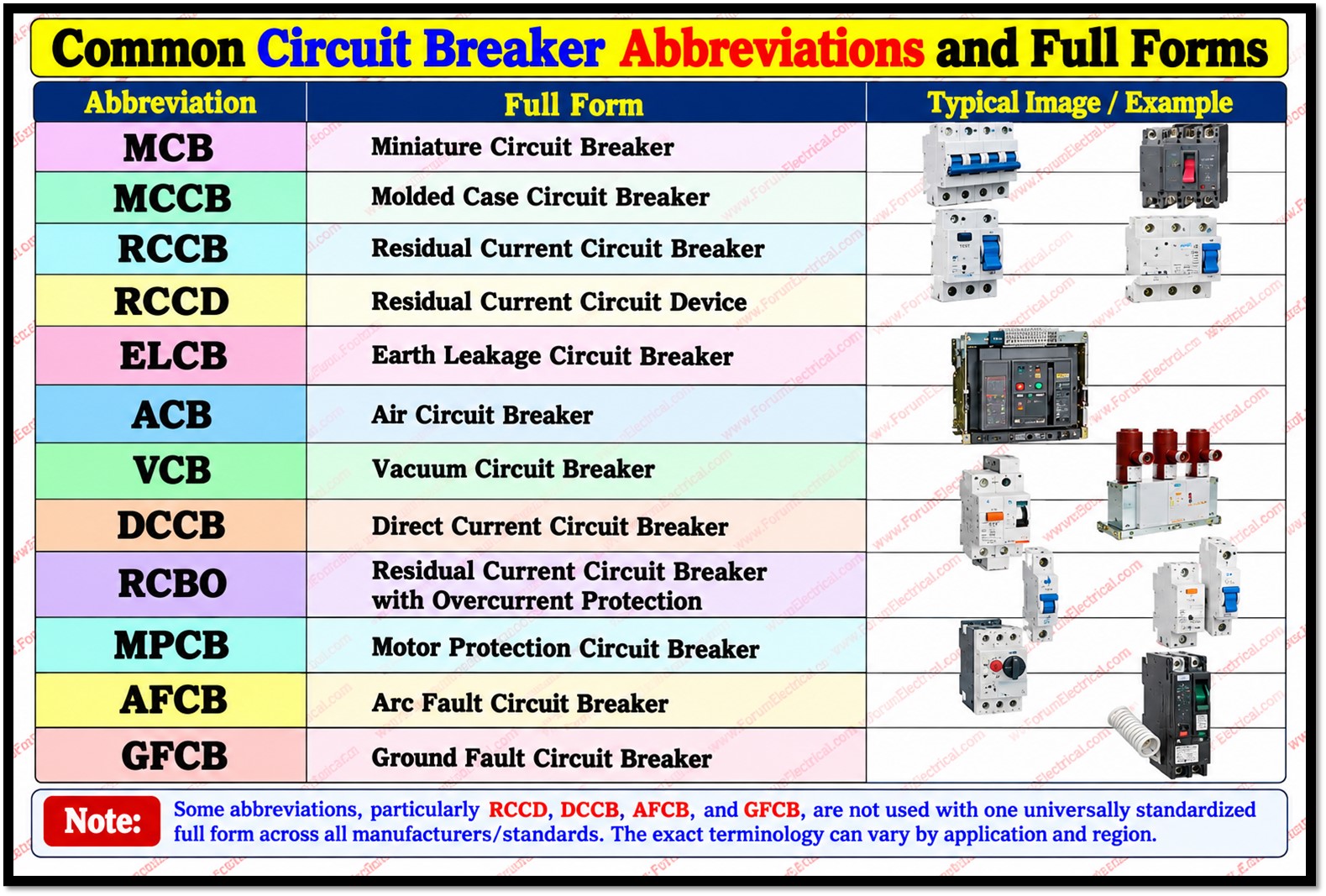
1). MCB – Miniature Circuit Breaker
Function: Protects electrical circuits against overload and short-circuit currents.
Common use: Homes, offices, lighting circuits, and small power circuits.
2). MCCB – Molded Case Circuit Breaker
Function: Provides overload and short-circuit protection and is suitable for higher current ratings than MCBs.
Common use: Industrial panels, commercial buildings, and large electrical systems.
3). RCCB – Residual Current Circuit Breaker
Function: Detects residual or earth-leakage current and disconnects the supply to help protect against electric shock.
Important: An RCCB generally does not provide overload or short-circuit protection by itself.
4). RCCD – Residual Current Circuit Device
Function: Detects residual or earth-leakage current and disconnects the circuit.
Note: Terminology varies by standard and region, while RCCB is a commonly used specific type of residual-current device.
5). ELCB – Earth Leakage Circuit Breaker
Function: Provides protection against earth-leakage conditions.
6). ACB – Air Circuit Breaker
Function: Uses air as the arc-extinguishing medium and provides protection against overload, short circuit, and other faults depending on the trip unit.
Common use: Main switchboards, industrial installations, and high-current electrical systems.
7). VCB – Vacuum Circuit Breaker
Function: Uses a vacuum interrupter to extinguish the electrical arc.
Common use: Medium-voltage systems, substations, and industrial power distribution.
8). DCCB – DC Circuit Breaker
Function: Designed to interrupt direct-current circuits and fault currents.
Common use: Solar PV systems, battery systems, DC distribution, and other DC applications.
9). RCBO – Residual Current Breaker with Overcurrent Protection
Function: Combines residual-current, overload, and short-circuit protection in a single device.
Common use: Individual final circuits requiring comprehensive protection.
10). MPCB – Motor Protection Circuit Breaker
Function: Protects motors against overload, short circuit, and, depending on the device, phase-loss or phase-failure conditions.
Common use: Motor control panels and industrial machinery.
11). AFCB – Arc-Fault Circuit Breaker
Function: Detects potentially dangerous electrical arc faults that can contribute to electrical fires.
Common use: Residential and commercial circuits where arc-fault protection is required.
12). GFCB – Ground-Fault Circuit Breaker
Function: Detects current flowing through an unintended ground or earth path and disconnects the circuit.
Purpose: Helps reduce the risk of electric shock and electrical fires.