The different types of relays & their protection are:
-
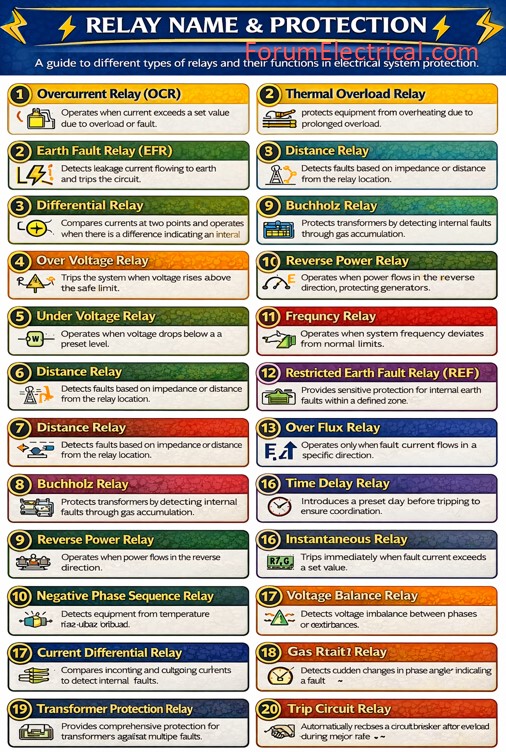
Overcurrent Relay (OCR) – It operates when current exceeds a preset value due to overload or fault.
-
Earth Fault Relay (EFR) – It detects leakage current flowing to earth and trips the circuit.
-
Differential Relay – It compares currents at two points and operates when there is a difference indicating an internal fault.
-
Over Voltage Relay – It trips the system when voltage rises above the safe limit.
-
Under Voltage Relay – It operates when voltage drops below a preset level.
-
Thermal Overload Relay – It protects equipment from overheating due to prolonged overload.
-
Distance Relay – It detects faults based on impedance or distance from the relay location.
-
Buchholz Relay – It protects transformers by detecting internal faults through gas accumulation.
-
Reverse Power Relay – It operates when power flows in the reverse direction, protecting generators.
-
Negative Phase Sequence Relay – It detects phase imbalance that causes heating in rotating machines.
-
Frequency Relay – It operates when system frequency deviates from normal limits.
-
Restricted Earth Fault Relay (REF) – It provides sensitive protection for internal earth faults within a defined zone.
-
Over Flux Relay – It protects transformers from overfluxing due to high V/Hz ratio.
-
Directional Overcurrent Relay – It operates only when fault current flows in a specific direction.
-
Time Delay Relay – It introduces a preset delay before tripping to ensure coordination.
-
Instantaneous Relay – It trips immediately when fault current exceeds a set value.
-
Voltage Balance Relay – It detects voltage imbalance between phases.
-
Phase Failure Relay – It operates when one or more phases are lost (single phasing).
-
Lockout Relay – It acts as a master relay to trip and lock the system during major faults.
-
Auxiliary Relay – It supports control and interlocking functions in protection circuits.
-
Current Balance Relay – It detects imbalance in current between phases.
-
Under Frequency Relay – It operates when system frequency falls below the set value.
-
Over Frequency Relay – It trips when system frequency exceeds the safe limit.
-
Pilot Relay – It uses communication signals for protection between two ends of a line.
-
Gas Relay – It detects gas formation in transformer oil indicating internal faults.
-
Out of Step Relay – It protects generators from instability due to loss of synchronism.
-
Sync Check Relay – It ensures proper synchronization before connecting two systems.
-
Vector Surge Relay – It detects sudden changes in phase angle indicating faults or disturbances.
-
Trip Circuit Supervision Relay – It monitors the health of the trip circuit continuously.
-
Auto Reclose Relay – It automatically recloses a circuit breaker after a temporary fault.
-
Thermal Relay – It protects equipment from temperature rise due to overload.
-
Rate of Rise Relay – It operates when current increases rapidly, indicating a fault.
-
Directional Earth Fault Relay – It detects the direction of earth fault current.
-
Power Factor Relay – It operates when power factor falls below a preset value.
-
Voltage Restraint Relay – It modifies relay operation based on voltage conditions.
-
Voltage Controlled Relay – It operates depending on voltage magnitude in addition to current.
-
Current Differential Relay – It compares incoming and outgoing currents to detect internal faults.
-
Transformer Protection Relay – It provides comprehensive protection for transformers against multiple faults.
-
Generator Protection Relay – It protects generators from electrical and mechanical faults.
-
Motor Protection Relay – It safeguards motors against overload, faults, and abnormal conditions.
-
Busbar Differential Relay – It detects faults within the busbar zone by comparing currents.
-
Arc Flash Relay – It detects arc faults using light and current sensing.
-
Phase Sequence Relay – It ensures correct phase sequence to prevent reverse rotation.
-
Dead Line Relay – It detects absence of voltage in a transmission line.
-
Field Failure Relay – It operates when excitation in a generator is lost.
-
Under Current Relay – It detects abnormally low current conditions.
-
Sensitive Earth Fault Relay – It detects very small leakage currents to earth.
-
Over Temperature Relay – It trips when temperature exceeds safe limits.
-
Winding Temperature Relay – It monitors transformer winding temperature to prevent damage.
-
Oil Level Relay – It operates when transformer oil level falls below the required level.