Difference between WTI and OTI in a Transformer
| Parameter | WTI (Winding Temperature Indicator) | OTI (Oil Temperature Indicator) |
|---|---|---|
| Full Form | Winding Temperature Indicator | Oil Temperature Indicator |
| Measures | Transformer winding temperature | Top oil temperature |
| Sensing Method | Combination of oil temperature sensing and CT-based heating simulation | Direct temperature sensing of transformer oil |
| Location | Mounted on transformer tank, connected with a heater element | Mounted on transformer tank with temperature bulb in oil pocket |
| Purpose | Monitors winding hot-spot temperature | Monitors top oil temperature |
| Accuracy | Represents actual winding temperature more closely | Represents oil temperature only |
| Protection Function | Provides alarm, cooling fan control, and trip signals based on winding temperature | Provides alarm, cooling fan control, and trip signals based on oil temperature |
| Temperature Rise | Usually higher than OTI due to load current heating | Lower than winding temperature |
| Current Dependency | Depends on transformer load current through CT | Independent of load current |
| Importance | Prevents winding insulation damage | Prevents oil overheating |
How WTI Works?
- Measures oil temperature.
- Uses a Current Transformer (CT) connected to the transformer load current.
- A heater coil inside the WTI simulates additional winding heat.
- Displays the estimated hot-spot winding temperature.
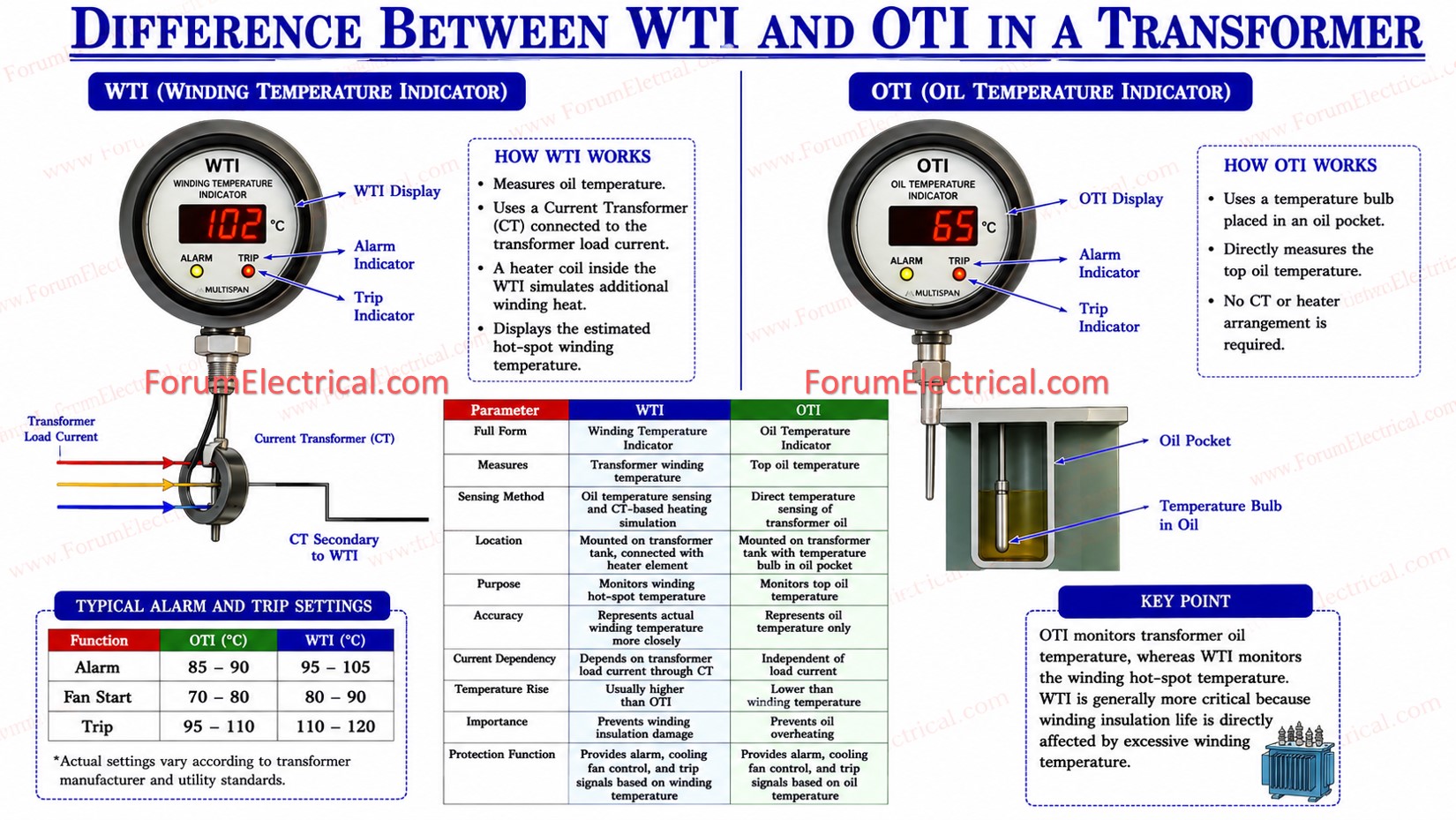
How OTI Works?
- Uses a temperature bulb placed in an oil pocket.
- Directly measures the top oil temperature.
- No CT or heater arrangement is required.
Typical Alarm and Trip Settings
| Function | OTI | WTI |
|---|---|---|
| Alarm | 85°C – 90°C | 95°C – 105°C |
| Fan Start | 70°C – 80°C | 80°C – 90°C |
| Trip | 95°C – 110°C | 110°C – 120°C |
Points to Remember
Actual settings vary according to transformer manufacturer and utility standards.
OTI monitors transformer oil temperature whereas WTI monitors the winding hot-spot temperature.
WTI is generally more critical because winding insulation life is directly affected by excessive winding temperature.