Difference between VFD and VSD
In modern industrial automation & motor control systems the terms
- Variable Frequency Drive (VFD) and
- Variable Speed Drive (VSD)
are often used interchangeably.
However they are not exactly the same.
Understanding the key difference between VFD & VSD is important for selecting the right motor control solution for all the industrial applications.
What is a Variable Frequency Drive (VFD)?
A Variable Frequency Drive (VFD) is an electronic device that is used to control the speed & torque of an AC motor by varying the frequency & voltage supplied to the motor.
By adjusting the output frequency a VFD allows accurate motor speed control, improved energy efficiency & reduced mechanical stress on equipment.
What is a Variable Speed Drive (VSD)?
A Variable Speed Drive (VSD) is a common term used for any device that controls the speed of a motor.
A VSD can include
- VFDs,
- DC drives,
- Hydraulic drives,
- Mechanical drives and
- Other speed control technologies.
Difference between VFD and VSD
VFD vs VSD
The primary difference is that a VFD controls motor speed by changing the electrical frequency supplied to an AC motor whereas a VSD refers to any method utilized to vary motor speed regardless of the technology employed.
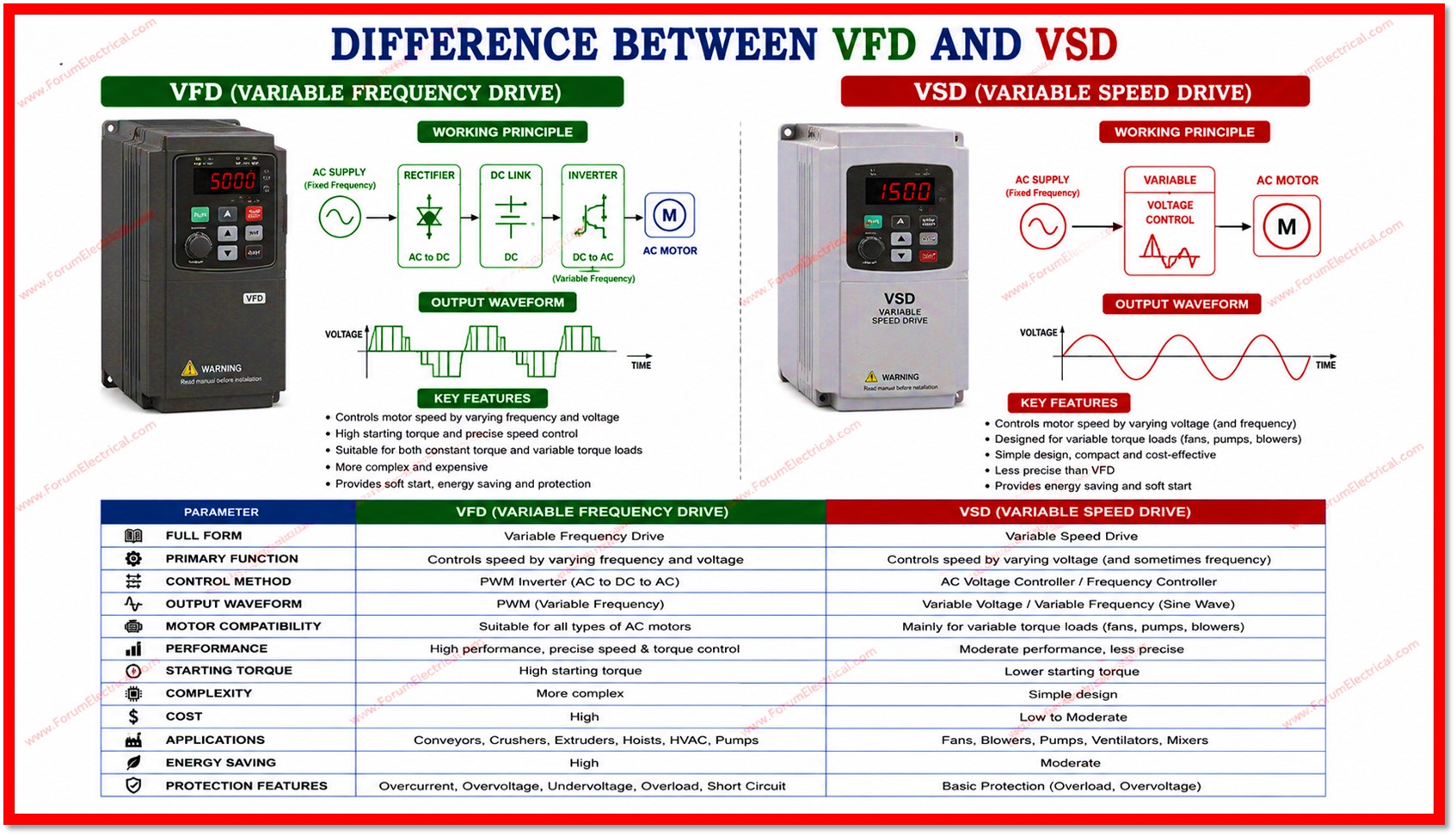
| Parameter | Variable Frequency Drive (VFD) | Variable Speed Drive (VSD) |
|---|---|---|
| Definition | A VFD controls the speed of an AC motor by varying the supply frequency and voltage. | A VSD controls the speed of a motor using any speed-control technology. |
| Scope | A VFD is a specific type of motor drive. | A VSD is a broad category that includes various drive technologies. |
| Motor Compatibility | A VFD is mainly used with AC motors. | A VSD can be utilized with AC motors, DC motors and other drive systems. |
| Operating Method | A VFD changes the frequency of the electrical supply to the control speed. | A VSD uses electrical, mechanical, hydraulic, or electronic methods to control speed. |
| Technology | A VFD uses frequency-conversion technology. | A VSD may use multiple speed-control technologies. |
| Application | A VFD is primarily used for AC motor speed control. | A VSD is used wherever variable motor speed is required. |
| Energy Efficiency | A VFD provides high energy savings in variable-load applications. | The efficiency of a VSD depends on the technology being used. |
| Examples | AC Drive, Inverter Drive, Frequency Converter. | VFD, DC Drive, Hydraulic Drive, and Mechanical Variable-Speed Drive. |
| Cost | A VFD is generally cost-effective for AC motor applications. | The cost of a VSD varies depending on the drive type. |
| Relationship | Every VFD is considered a VSD. | Not every VSD is a VFD. |