Difference between Varistors and Thermistors
Thermistors and varistors are important components used in electronic circuits, but they respond to different electrical conditions. Understanding their characteristics helps in selecting the right component for circuit protection.
Thermistor (NTC)
An NTC thermistor decreases its resistance as its temperature rises. It is commonly used to limit inrush current when a circuit is powered on. Under normal operating conditions, it has relatively low resistance and allows current to flow.
Varistor (MOV)
A metal oxide varistor (MOV) is designed to protect circuits against voltage surges. Under normal voltage conditions, it has very high resistance and draws very little current. When a voltage surge exceeds its conduction threshold, its resistance drops sharply, allowing it to divert surge current and help protect sensitive components.
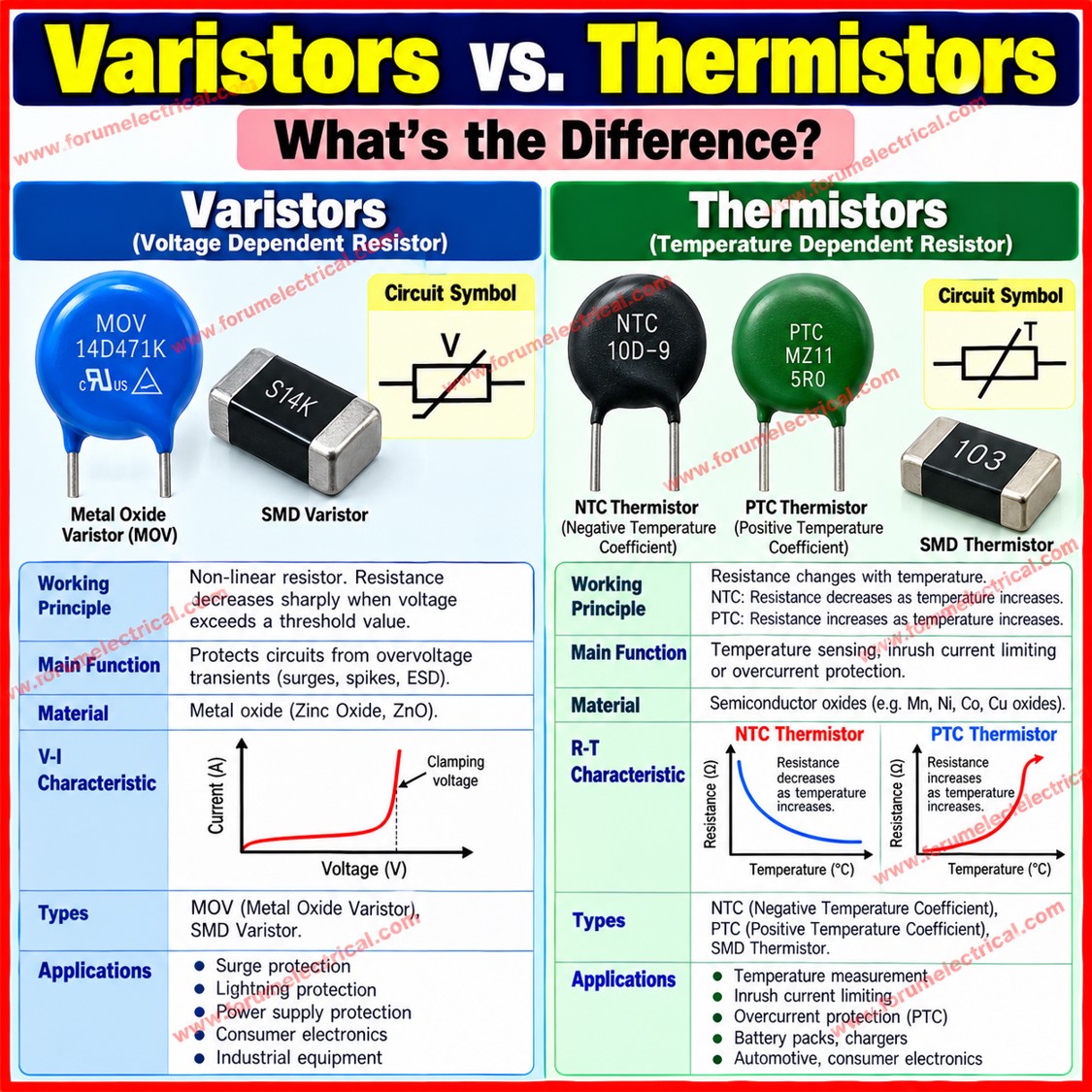
Varistors vs. Thermistors
| Feature | Thermistor (NTC) | Varistor (MOV) |
|---|---|---|
| Full Name | Negative Temperature Coefficient Thermistor | Metal Oxide Varistor |
| Operating Principle | Responds to temperature changes | Responds to voltage changes |
| Resistance Behavior | Resistance decreases as temperature increases | Resistance decreases sharply when voltage exceeds its threshold |
| Normal Condition | Relatively low resistance during normal operation | Very high resistance under normal voltage |
| Main Function | Limits inrush current during startup | Protects circuits against voltage surges |
| Typical Application | Power supplies, motor circuits, and electronic equipment | Surge protection in power supplies, control panels, and electronic devices |
| Protection Type | Inrush current limiting | Overvoltage and transient surge protection |
An NTC thermistor responds primarily to temperature, whereas a varistor responds primarily to voltage. They are not interchangeable because each performs a different function in circuit protection.