Difference between Standard PLC and Safety PLC
Standard PLC vs Safety PLC
Programmable Logic Controllers (PLCs) are widely used in industrial automation for controlling machines and processes.
However when human safety and important protection systems are involved Safety PLCs are used instead of standard **PLC**s.
Safety PLCs are specifically designed to meet functional safety standards and ensure safe operation even when faults occur.
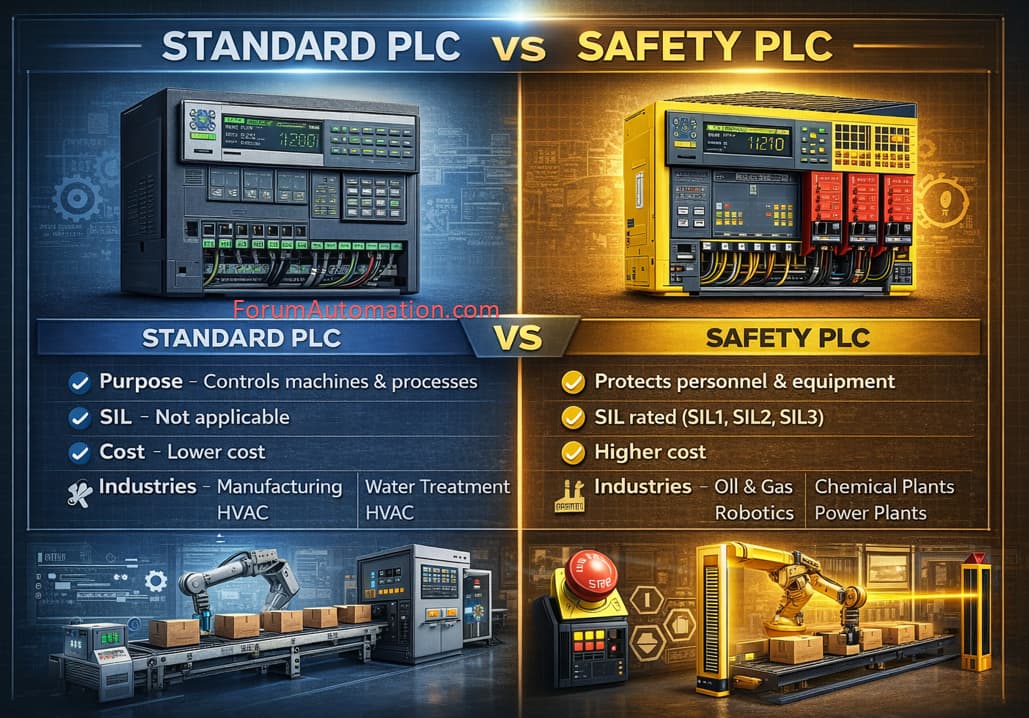
Standard PLC vs Safety PLC
| Parameters | Standard PLC | Safety PLC |
|---|---|---|
| Purpose | Used for general automation and process control | Used for safety-critical control systems |
| Primary Function | Controls machines, processes, and equipment | Protects personnel and equipment from hazardous conditions |
| Safety Certification | Usually not certified for safety applications | Certified according to safety standards |
| Standards Compliance | General industrial standards | IEC 61508, IEC 62061, ISO 13849 |
| Fault Detection | Limited diagnostic capability | Advanced fault detection and self-diagnostics |
| Redundancy | Typically single-channel architecture | Often dual-channel or redundant architecture |
| Programming Environment | Standard PLC programming | Specialized safety-certified programming environment |
| Response to Faults | May continue operating even during faults | Automatically transitions to a safe state |
| Applications | Conveyor control, motor control, packaging machines | Emergency stop systems, safety interlocks, safety light curtains |
| Reliability Level | Standard reliability | High reliability for safety-critical applications |
| Safety Integrity Level (SIL) | Not applicable | SIL rated (SIL1, SIL2, SIL3 depending on system) |
| Monitoring | Basic process monitoring | Continuous safety monitoring |
| Cost | Lower cost | Higher cost due to safety design and certification |
| Typical Industries | Manufacturing, water treatment, HVAC | Oil & gas, chemical plants, robotics, power plants |
You can also follow us on AutomationForum.co, Facebook and Linkedin to receive daily Instrumentation updates.
You can also follow us on ForumElectrical.com , Facebook and Linkedin to receive daily Electrical updates.