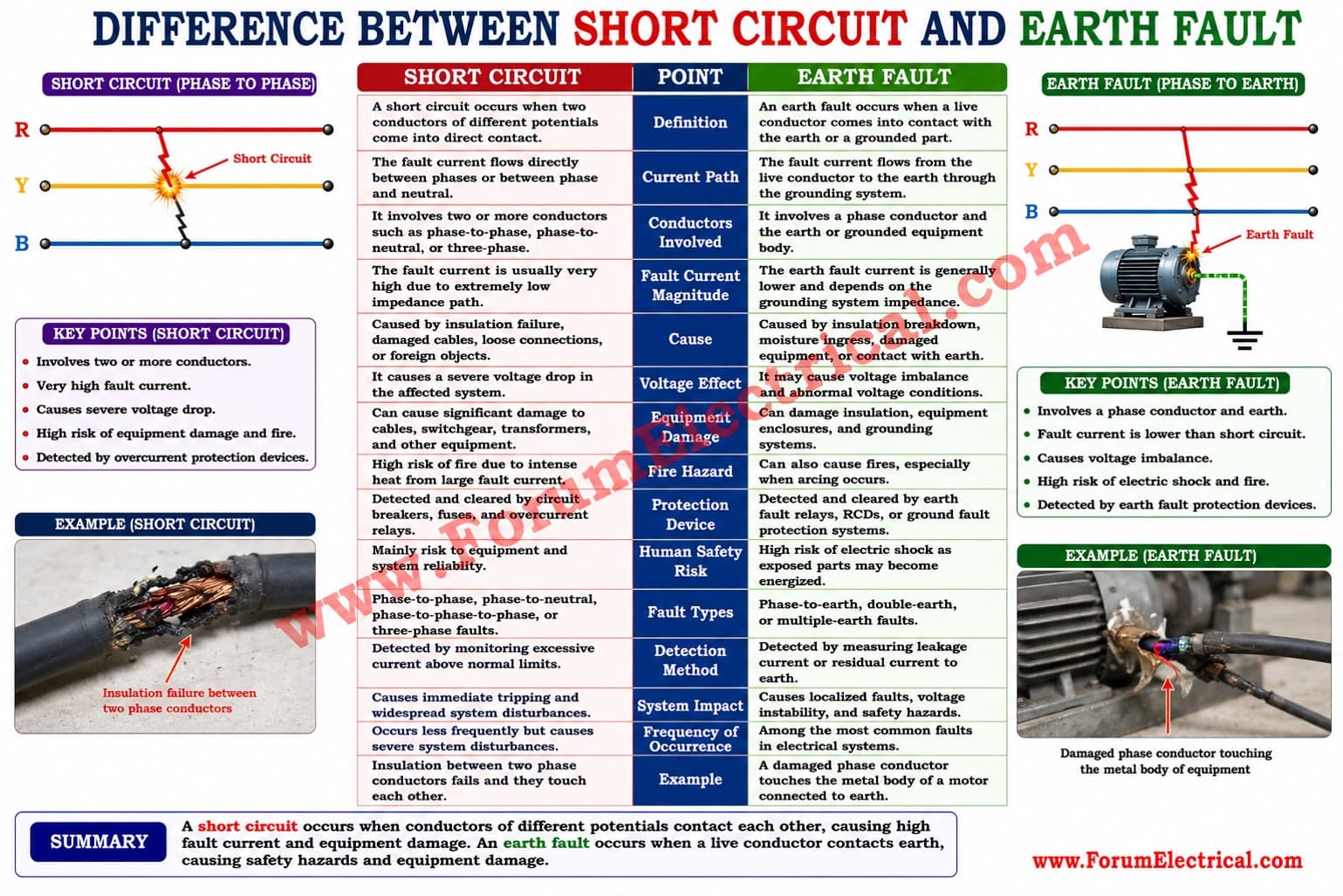
Difference between Short Circuit and Earth Fault
A short circuit and an earth fault are both electrical faults, but they happen in different ways.
| Short Circuit | Earth Fault |
|---|---|
| A short circuit occurs when 2 conductors having different electrical potentials come into direct contact with each other. | An earth fault occurs when a live conductor comes into contact with the earth or any grounded metallic part. |
| A short circuit can occur between phase-to-phase, phase-to-neutral, or phase-to-phase-to-phase conductors. | An earth fault generally occurs between a phase conductor and the earth. |
| The fault current in a short circuit is usually very high because the impedance of the fault path is extremely low. | The fault current in an earth fault may be lower or higher depending on the grounding system and fault resistance. |
| A short circuit mainly affects the electrical conductors involved in the fault. | An earth fault mainly affects the insulation system and grounded equipment. |
| The primary cause of a short circuit is insulation failure, damaged cables, loose connections, or accidental conductor contact. | The primary cause of an earth fault is insulation breakdown that allows current to flow to earth. |
| A short circuit can produce severe heating, arcing, and mechanical stress in electrical equipment. | An earth fault can create dangerous touch voltages and pose a serious shock hazard to personnel. |
| Protection against short circuits is generally provided by fuses, MCCBs, ACBs, and overcurrent relays. | Protection against earth faults is generally provided by earth fault relays, residual current devices (RCDs), and earth leakage circuit breakers (ELCBs). |
| A short circuit may occur without any connection to the earth. | An earth fault always involves an unintended connection to the earth. |
| Short-circuit faults are commonly classified as symmetrical or unsymmetrical faults. | Earth faults are classified as single-line-to-ground, double-line-to-ground, or ground-related faults. |
| The main concern in a short circuit is equipment damage due to excessive fault current. | The main concern in an earth fault is personnel safety and equipment insulation damage. |
| A short circuit generally causes an immediate and significant drop in system voltage. | An earth fault may cause voltage imbalance and neutral shift in the system. |
| Short-circuit protection settings are usually based on maximum fault current levels. | Earth fault protection settings are usually based on leakage current or ground fault current levels. |
| A short circuit can occur in both grounded and ungrounded systems. | An earth fault is more significant in grounded systems where a return path through earth exists. |
| The fault path in a short circuit is through another conductor. | The fault path in an earth fault is through the earth or grounded structures. |
| Short circuits are generally detected by overcurrent protection devices. | Earth faults are generally detected by earth fault relays or residual current sensing devices. |