Difference between Power Circuits and Control Circuits
Power Circuits vs Control Circuits
Power circuits and control circuits are the two fundamental parts of any electrical system.
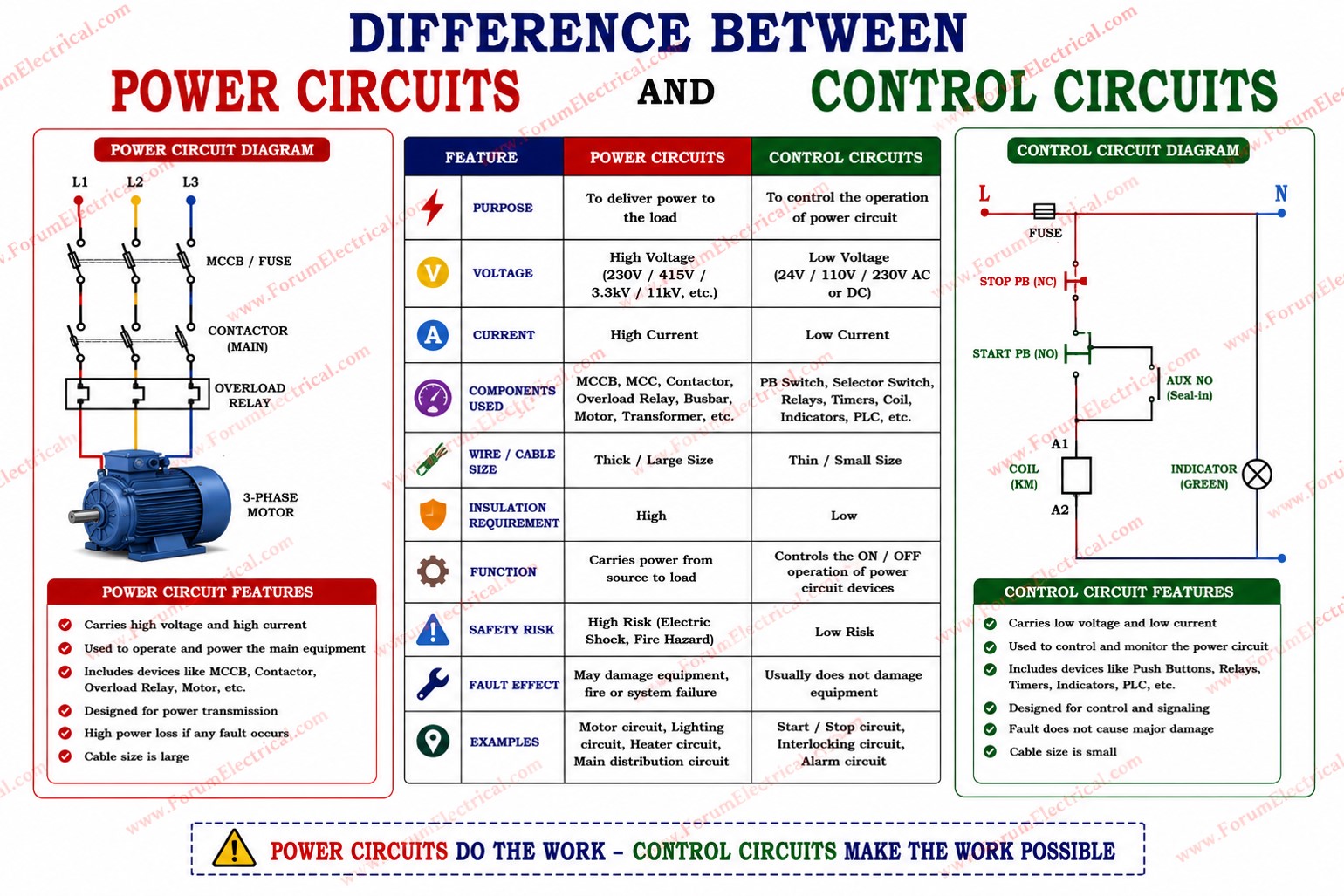
The power circuit carries electrical energy to operate loads such as motors, heaters, and transformers, while the control circuit manages the operation of the power circuit using switches, relays, contactors, sensors, timers, and PLCs. Together, they ensure safe, efficient, and reliable operation of electrical equipment.
| Parameter | Power Circuit | Control Circuit |
|---|---|---|
| Purpose | Delivers electrical power to the load | Controls the operation of the power circuit |
| Function | Drives motors, heaters, transformers, and other loads | Starts, stops, protects, and automates equipment |
| Voltage Level | Usually high (230 V, 415 V, 11 kV, etc.) | Usually low (24 V DC, 24 V AC, 48 V, 110 V, 230 V AC) |
| Current Level | High current | Low current |
| Power Rating | High power | Very low power |
| Main Components | Circuit breaker, MCCB, fuse, contactor main contacts, overload relay, cables, motor | Push buttons, selector switches, limit switches, timers, relays, PLC, contactor coil, sensors |
| Wire Size | Thick conductors to carry load current | Thin conductors since current is small |
| Load Connection | Connected directly to the electrical load | Connected to control devices and relay/contactor coils |
| Protection | Protects against overload and short circuit | Protects the control system and ensures safe operation |
| Switching Device | Main contacts of contactors or circuit breakers | Auxiliary contacts, relays, PLC outputs, contactor coils |
| Safety | Higher electrical hazard due to high voltage/current | Safer because of lower voltage and current |
| Energy Consumption | High | Very low |
| Failure Effect | Load stops or equipment may be damaged | Control sequence fails, but power components may remain healthy |
| Typical Applications | Motors, pumps, compressors, transformers, industrial machines | Motor starters, automation panels, PLC systems, interlocking and protection circuits |