Difference between MOSFET and BJT
MOSFET (Metal Oxide Semiconductor Field Effect Transistor) and BJT (Bipolar Junction Transistor) are two widely used semiconductor devices for switching and amplification applications.
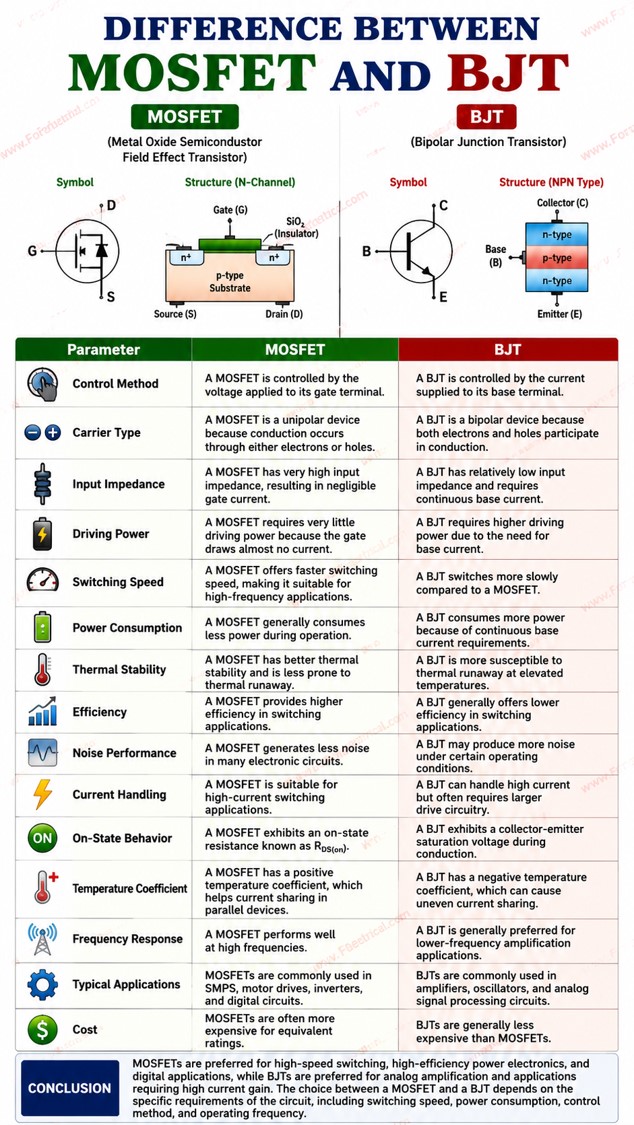
A MOSFET is a voltage-controlled device that operates using an electric field, while a BJT is a current-controlled device that operates through current flow between its terminals. MOSFETs are commonly used in high-speed switching circuits, power electronics, and digital systems, whereas BJTs are often used in analog amplification and low-frequency applications.
| Parameter | MOSFET | BJT |
|---|---|---|
| Full Form | MOSFET stands for Metal Oxide Semiconductor Field Effect Transistor. | BJT stands for Bipolar Junction Transistor. |
| Control Method | A MOSFET is controlled by the voltage applied to its gate terminal. | A BJT is controlled by the current supplied to its base terminal. |
| Carrier Type | A MOSFET is a unipolar device because conduction occurs through either electrons or holes. | A BJT is a bipolar device because both electrons and holes participate in conduction. |
| Input Impedance | A MOSFET has very high input impedance, resulting in negligible gate current. | A BJT has relatively low input impedance and requires continuous base current. |
| Driving Power | A MOSFET requires very little driving power because the gate draws almost no current. | A BJT requires higher driving power due to the need for base current. |
| Switching Speed | A MOSFET offers faster switching speed, making it suitable for high-frequency applications. | A BJT switches more slowly compared to a MOSFET. |
| Power Consumption | A MOSFET generally consumes less power during operation. | A BJT consumes more power because of continuous base current requirements. |
| Thermal Stability | A MOSFET has better thermal stability and is less prone to thermal runaway. | A BJT is more susceptible to thermal runaway at elevated temperatures. |
| Efficiency | A MOSFET provides higher efficiency in switching applications. | A BJT generally offers lower efficiency in switching applications. |
| Noise Performance | A MOSFET generates less noise in many electronic circuits. | A BJT may produce more noise under certain operating conditions. |
| Current Handling | A MOSFET is suitable for high-current switching applications. | A BJT can handle high current but often requires larger drive circuitry. |
| On-State Behavior | A MOSFET exhibits an on-state resistance known as RDS(on). | A BJT exhibits a collector-emitter saturation voltage during conduction. |
| Temperature Coefficient | A MOSFET has a positive temperature coefficient, which helps current sharing in parallel devices. | A BJT has a negative temperature coefficient, which can cause uneven current sharing. |
| Frequency Response | A MOSFET performs well at high frequencies. | A BJT is generally preferred for lower-frequency amplification applications. |
| Typical Applications | MOSFETs are commonly used in SMPS, motor drives, inverters, and digital circuits. | BJTs are commonly used in amplifiers, oscillators, and analog signal processing circuits. |
| Cost | MOSFETs are often more expensive for equivalent ratings. | BJTs are generally less expensive than MOSFETs. |