What is the difference between Megger and Hipot?
The difference between Megger Test and Hi-Pot Test are widely used in
- Motors,
- Transformers,
- Cables and
- Switchgear testing.
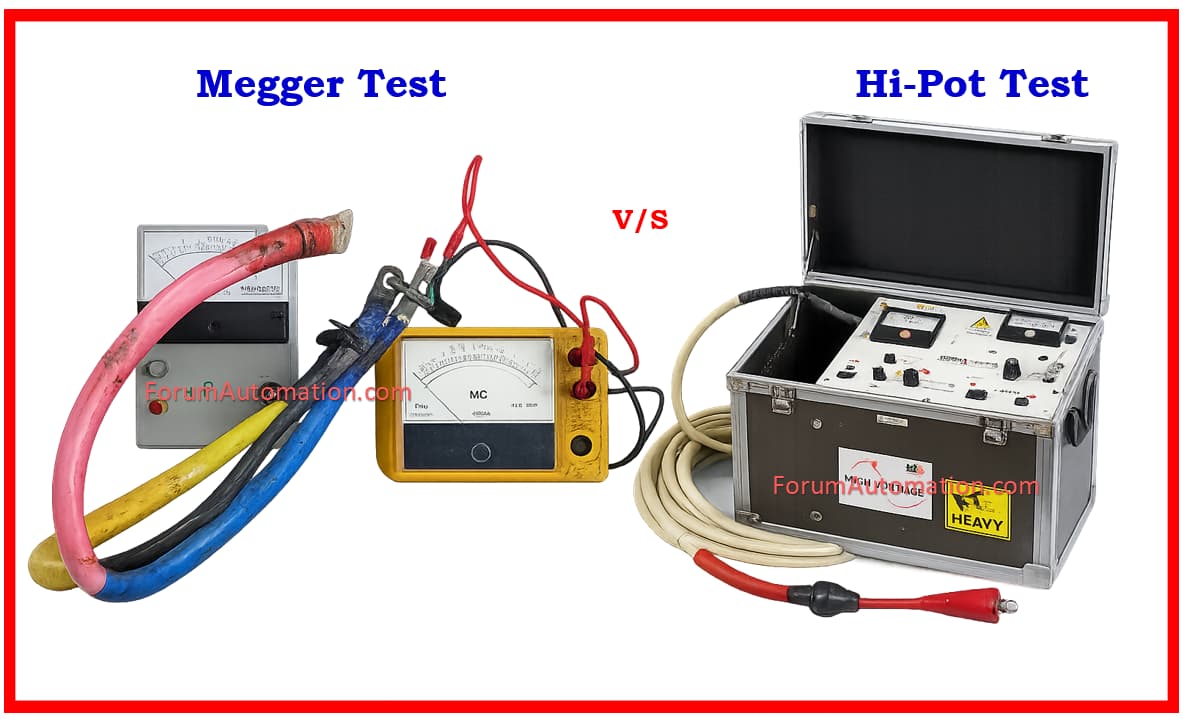
Difference between Megger Test and Hi-Pot Test
| Parameter | Megger Test | Hi-Pot Test |
|---|---|---|
| (Insulation Resistance Test) | (High Potential Test) | |
| Purpose | Used to measures insulation resistance value | Used to tests insulation strength and breakdown capability |
| Main Function | Helps to detects insulation deterioration, moisture, and leakage | Used to verifies insulation can withstand high voltage stress |
| Test Voltage Type | DC Voltage | AC or DC Voltage |
| Voltage Level | Low to Medium (250V to 10kV typical) | Very High Voltage (2kV to 100kV depending on equipment) |
| Measurement | Provides resistance value in Megaohms (MΩ or GΩ) | Provides leakage current value in mA or µA |
| Test Nature | Non-destructive test | Potentially destructive test if insulation is weak |
| Risk to Equipment | Safe for the routine maintenance | Can damage the insulation if weak (or) defective |
| Usage Frequency | Routine maintenance test | Commissioning or periodic certification test |
| Detects | Moisture, contamination & insulation aging | Insulation breakdown & dielectric strength |
| Output Result | Insulation Resistance value (e.g., 500 MΩ) | Pass (or) Fail based on leakage current |
| Equipment Used | Megger (Insulation Resistance Tester) | Hi-Pot Tester |
| Test Duration | Short (usually 1 minute) | Longer (1–10 minutes typical) |
| Application Stage | Preventive maintenance | Factory testing, commissioning, and safety certification |
| Safety Level | Lower risk compared to Hi-Pot | Higher risk due to high voltage |
You can also follow us on [color=#ff7700]AutomationForum.co[/color], [url= https://www.facebook.com/instrumentation.control][color=#1E00A3]Facebook[/color][/url] and [url= https://www.linkedin.com/showcase/81532759/feed/posts/][color=#1E00A3]Linkedin[/color][/url] to receive daily Instrumentation updates.
You can also follow us on [color=#ff7700] ForumElectrical.com [/color], [color=#1E00A3] Facebook [/color] and [color=#1E00A3] Linkedin[/color] to receive daily Electrical updates.