Difference between High Tension and Low Tension Panels
What is an HT Panel?
An HT Panel (High Tension Panel) is designed to operate at voltages above 1 kV, typically 3.3 kV, 6.6 kV, 11 kV, 22 kV, or 33 kV.
It receives power from utility substations or transformers and safely controls, protects, and isolates high-voltage electrical circuits.
HT panels commonly include Vacuum Circuit Breakers (VCBs), protection relays, current transformers (CTs), potential transformers (PTs), busbars, and earthing switches.
What is an LT Panel?
An LT Panel (Low Tension Panel) operates at voltages up to 1 kV, with 415 V and 230 V being the most common.
It distributes power from transformers to motors, lighting systems, HVAC equipment, and other low-voltage loads.
LT panels typically use Air Circuit Breakers (ACBs), Molded Case Circuit Breakers (MCCBs), Miniature Circuit Breakers (MCBs), contactors, overload relays, and metering devices.
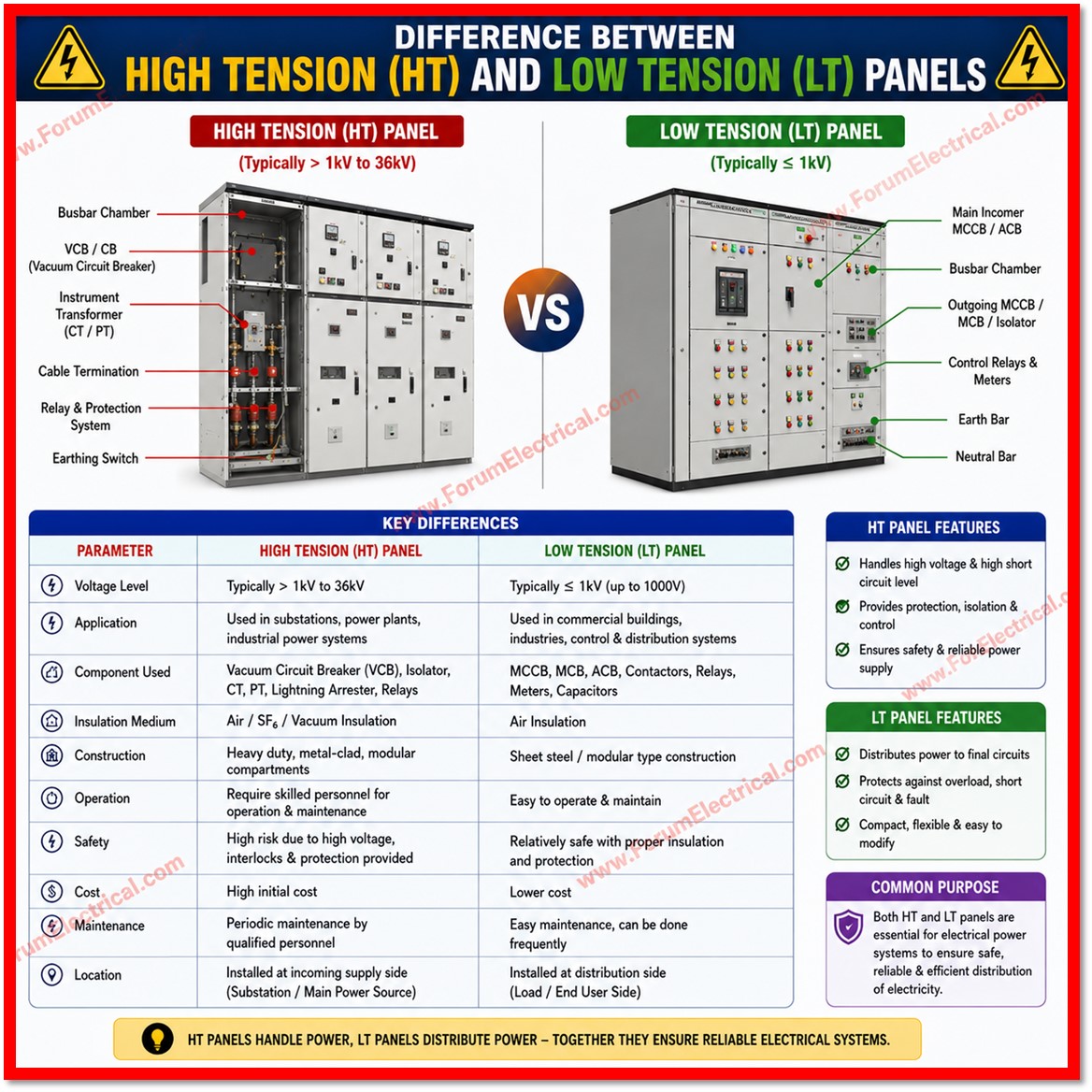
Difference between High Tension and Low Tension Panels
HT Panel vs LT Panel
| Parameter | HT Panel | LT Panel |
|---|---|---|
| Full Form | High Tension Panel | Low Tension Panel |
| Operating Voltage | Above 1 kV | Up to 1 kV |
| Common Voltages | 3.3 kV, 6.6 kV, 11 kV, 33 kV | 230 V, 415 V |
| Primary Function | High-voltage switching and protection | Low-voltage power distribution |
| Incoming Supply | Utility grid | Distribution transformer |
| Circuit Breakers | VCB, SF6 CB | ACB, MCCB, MCB |
| Protection Relays | Numerical protection relays | Overload and protection relays |
| Busbar Rating | Medium-voltage insulated busbars | Copper or aluminum busbars |
| Safety Features | Arc-resistant design, interlocks | Interlocks and overload protection |
| Applications | Substations, industries | Buildings, factories, commercial facilities |