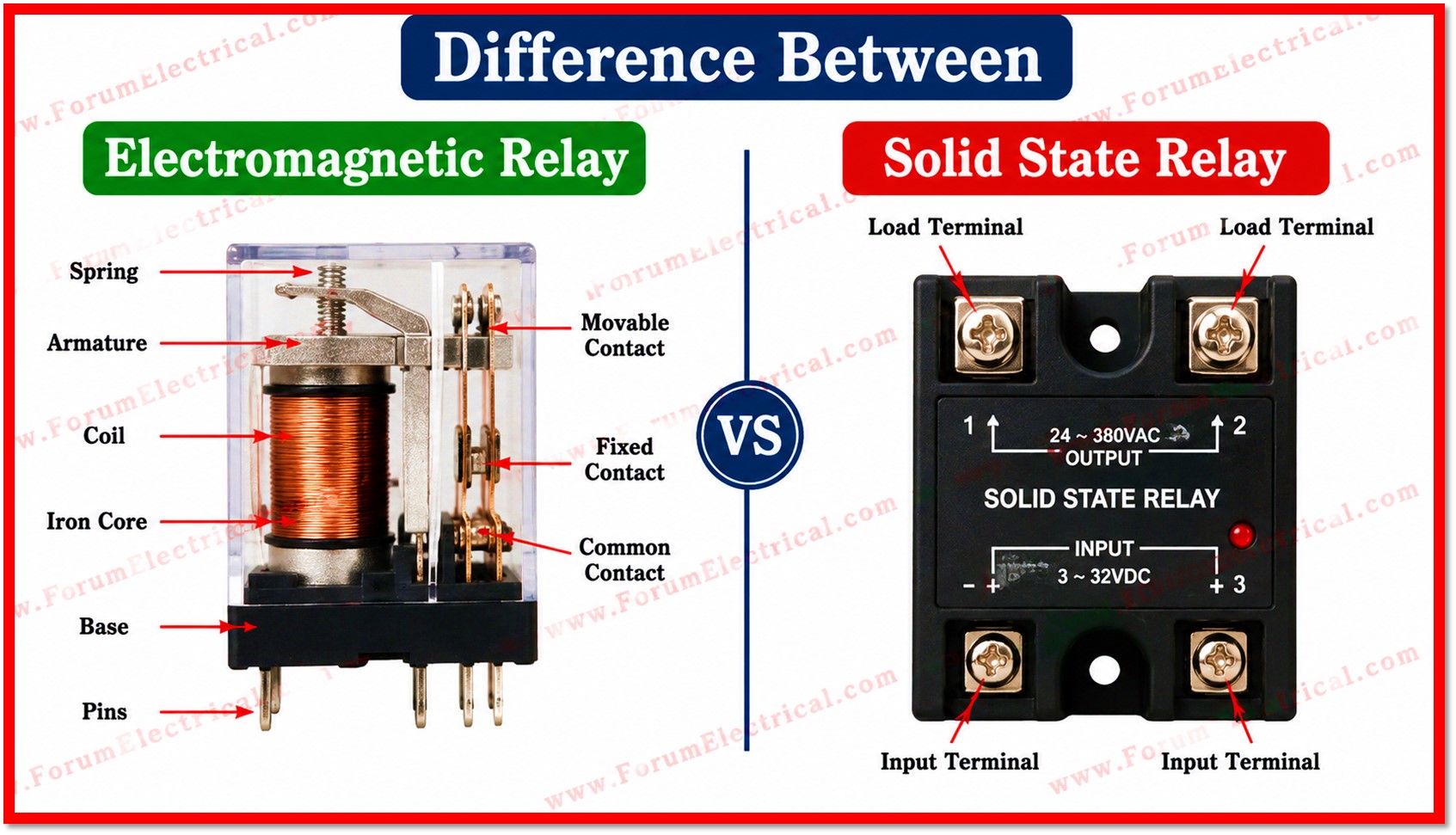
| Working Principle |
Uses an electromagnetic coil to mechanically move contacts. |
Uses semiconductor devices (SCR, TRIAC, MOSFET, or transistor) to switch loads electronically. |
| Moving Parts |
Yes, contains moving contacts and armature. |
No moving parts. |
| Switching Speed |
Slow (typically 5–20 ms). |
Very fast (typically less than 1 ms). |
| Operating Noise |
Produces an audible clicking sound. |
Silent operation. |
| Mechanical Life |
Limited due to wear of contacts (typically 1–10 million operations). |
Extremely long because there are no mechanical contacts (often over 100 million operations). |
| Electrical Life |
Limited by contact arcing and erosion. |
Longer electrical life under proper operating conditions. |
| Contact Wear |
Contacts wear out due to arcing. |
No contact wear since switching is electronic. |
| Switching Frequency |
Suitable for low-frequency switching. |
Ideal for high-frequency and rapid switching. |
| Power Consumption |
Coil continuously consumes power while energized. |
Low control power requirement. |
| Heat Generation |
Minimal heat generation. |
Generates heat in semiconductor devices; usually requires a heat sink for high currents. |
| Voltage Drop |
Very low across closed contacts. |
Has a small voltage drop (typically 1–2 V) across the semiconductor. |
| Leakage Current |
No leakage current when OFF. |
Small leakage current exists even when OFF. |
| Isolation |
Excellent galvanic isolation through mechanical contacts. |
Electrical isolation provided using an optocoupler in most SSRs. |
| Contact Bounce |
Contact bounce may occur during switching. |
No contact bounce. |
| Resistance to Vibration |
Less resistant because of moving parts. |
Highly resistant to shock and vibration. |
| Maintenance |
Requires periodic inspection and replacement of worn contacts. |
Virtually maintenance-free. |
| Load Types |
Suitable for AC and DC loads of various ratings. |
Available for AC, DC, or both depending on the semiconductor used. |
| Overload Capability |
Better short-duration overload tolerance. |
Sensitive to overcurrent; often requires external protection such as fast-acting fuses. |
| EMI Generation |
Minimal electromagnetic interference. |
Can generate EMI during switching unless properly designed. |
| Cost |
Generally lower initial cost. |
Higher initial cost but lower maintenance costs. |
| Typical Applications |
Motor starters, control panels, power distribution, protection relays, automotive circuits. |
PLC outputs, industrial automation, temperature controllers, semiconductor manufacturing, high-speed switching applications. |