Difference between ELCB and RCCB
In electrical systems, protection against leakage current is critical to prevent electric shock, fire hazards and equipment damage. Two commonly used protective devices are:
- ELCB (Earth Leakage Circuit Breaker)
- RCCB (Residual Current Circuit Breaker)
Although both serve similar purposes, their working principles, sensitivity, and reliability differ significantly.
What is ELCB (Earth Leakage Circuit Breaker)?
ELCB is a device used to detect leakage current by monitoring voltage in the earth conductor.
Working Principle
It measures voltage between earth and equipment body
If leakage occurs → voltage rises → ELCB trips
Typically operates at around 50V threshold
Types of ELCB
- Voltage Operated ELCB (Old Type)
- Current Operated ELCB (Now replaced by RCCB)
Key Features
- Requires proper earthing connection.
- Detects only earth leakage through ground wire.
- Cannot detect leakage if no earth path exists.
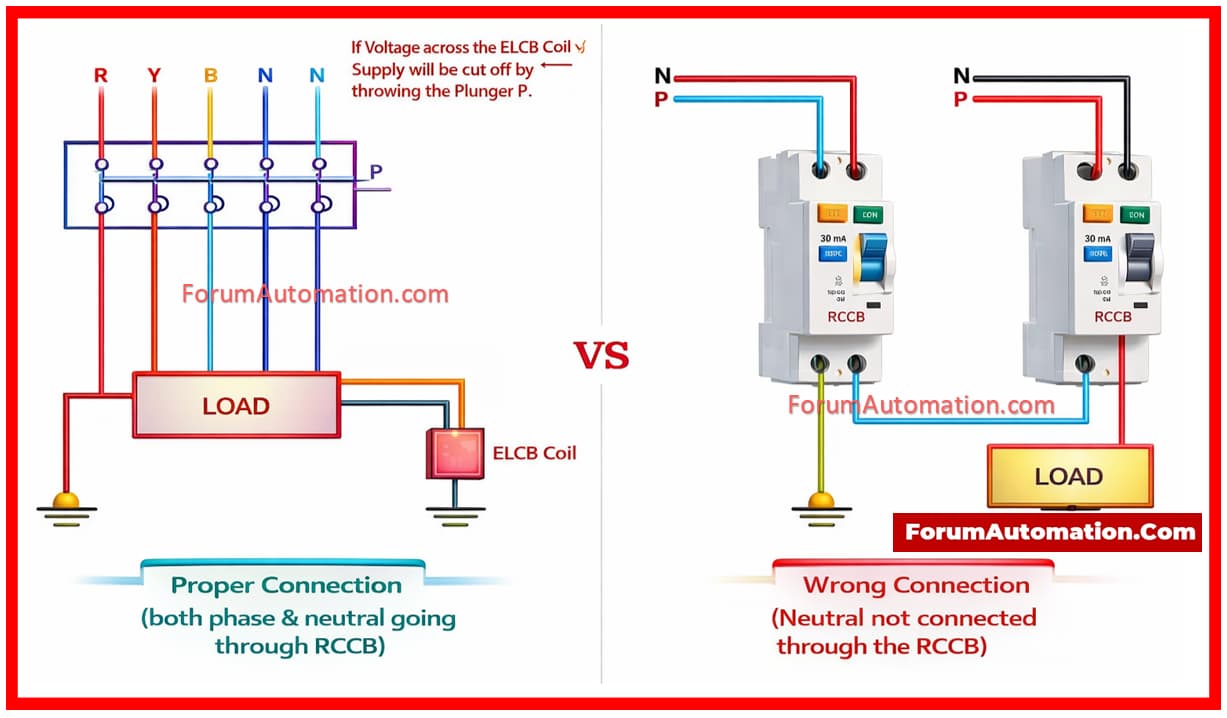
What is RCCB (Residual Current Circuit Breaker)?
RCCB is an advanced protective device that detects imbalance between phase and neutral current.
Working Principle
Uses Kirchhoff’s Current Law (KCL)
Current entering (Phase) = Current leaving (Neutral)
If difference occurs → leakage → RCCB trips instantly
Sensitivity Levels
30 mA → Human protection
100 mA / 300 mA → Fire protection
Key Features
- Does not require earthing to detect leakage.
- High sensitivity and fast operation.
- Widely used in modern installations.
Difference between ELCB and RCCB
| Feature | ELCB | RCCB |
|---|---|---|
| Full Form | Earth Leakage Circuit Breaker | Residual Current Circuit Breaker |
| Working Principle | Voltage sensing | Current imbalance sensing |
| Dependency | Requires earthing | Independent of earthing |
| Sensitivity | Low | High |
| Safety Level | Less reliable | Highly reliable |
| Leakage Detection | Only through earth wire | Any leakage (phase to ground) |
| Usage | Obsolete / Old systems | Modern installations |
Why RCCB is Preferred over ELCB?
- Detects all types of leakage currents.
- Works even if earthing is poor (or) absent.
- Faster tripping → better human safety.
- Compact and widely available.
- Complies with modern electrical standards.
Because of these advantages ELCB is now mostly replaced by RCCB.
While both ELCB and RCCB are designed for leakage protection, RCCB is far superior in terms of safety, reliability and performance.
Modern electrical systems strongly recommend RCCB for effective protection against electric shock and fire hazards.