| Type of Output |
An AC generator produces alternating current that changes direction periodically. |
A DC generator produces direct current that flows in only one direction. |
| Working Principle |
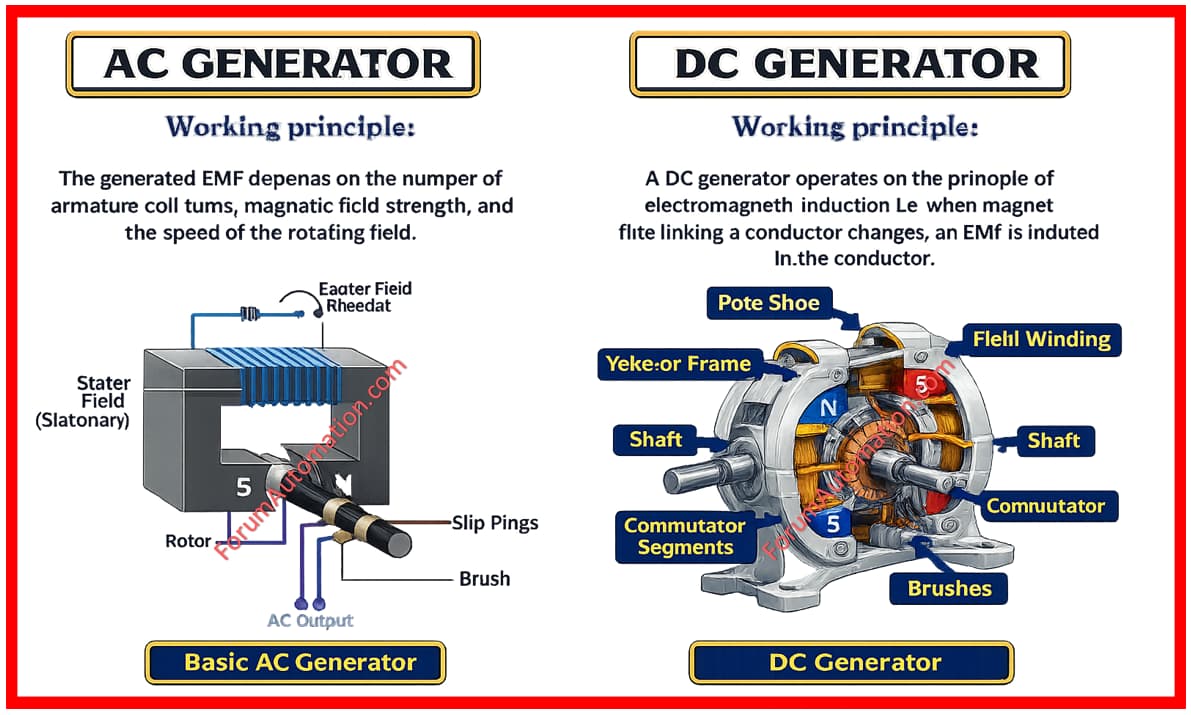
It works on electromagnetic induction with a rotating magnetic field. |
It works on electromagnetic induction with a rotating armature. |
| Commutation Method |
It uses slip rings to transfer current from the rotating part to the external circuit. |
It uses a commutator to convert induced AC into DC. |
| Output Waveform |
The output waveform is sinusoidal in nature. |
The output is pulsating DC which is made smoother using filters. |
| Maintenance Requirement |
It requires less maintenance due to the absence of commutator sparking. |
It requires more maintenance because of brush and commutator wear. |
| Efficiency |
It generally has higher efficiency in operation. |
It has comparatively lower efficiency due to mechanical losses. |
| Construction |
Its construction is simpler and more robust. |
Its construction is more complex due to the commutator mechanism. |
| Applications |
It is widely used in power generation and transmission systems. |
It is used in battery charging, electroplating, and DC supply systems. |
| Voltage Generation |
It generates high voltage suitable for long-distance transmission. |
It generates comparatively lower voltage levels. |