The Dynamic Contact Resistance Measurement (DCRM) Test is a specialized diagnostic test performed on high-voltage circuit breakers, particularly SF₆, vacuum, and oil circuit breakers, to evaluate the condition of the main and arcing contacts during breaker operation.
Unlike a normal static contact resistance test, DCRM measures the contact resistance continuously while the circuit breaker opens or closes, providing a dynamic resistance profile (graph) of the contact movement.
Purpose of DCRM Test
The DCRM test is mainly conducted to:
- Assess the health of main and arcing contacts
- Detect contact wear, erosion, or damage
- Verify contact timing and travel performance
- Identify abnormalities in contact overlap
- Detect misalignment or mechanical issues inside the breaker
- Prevent unexpected breaker failure
This test is especially important for high-voltage circuit breakers (33 kV, 66 kV, 110 kV, 220 kV and above) where breaker reliability is critical.
Principle of DCRM Test
In a DCRM test:
A constant DC test current (typically 100 A or more) is injected through the circuit breaker contacts.
The breaker is operated (opening or closing operation).
During movement, the test instrument continuously records the contact resistance variation versus time.
The result is displayed as a dynamic resistance curve (graph).
The graph helps engineers understand the transition between main contacts and arcing contacts.
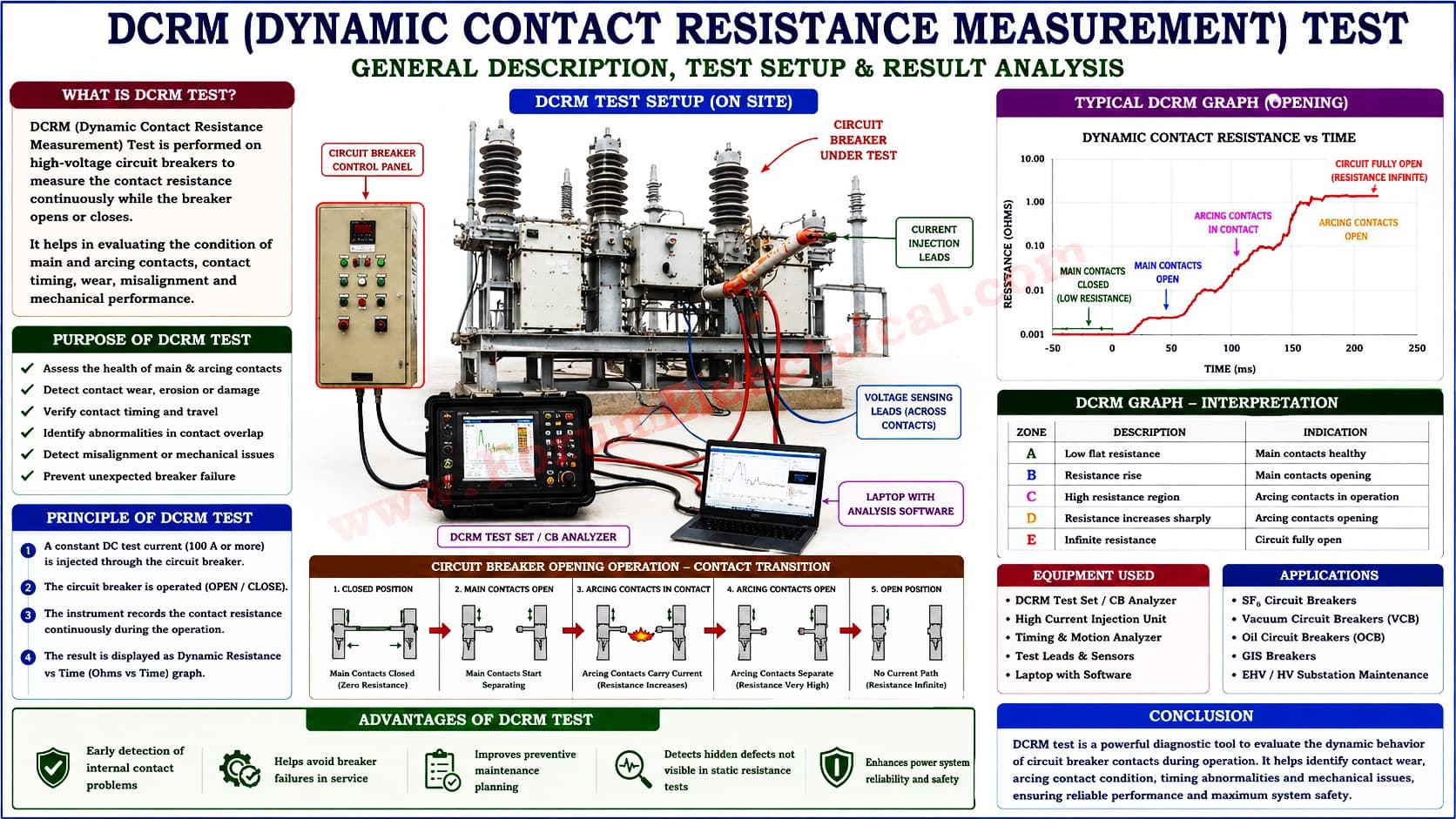
How DCRM Works?
When the breaker starts operating:
- Main contacts separate first
- Arcing contacts continue carrying current temporarily
- Resistance changes dynamically during this transition
- Finally, resistance becomes infinite after full contact separation
A healthy breaker shows a smooth and stable resistance curve, whereas defects appear as:
- Sudden spikes in resistance
- Irregular waveform patterns
- High resistance values
- Interrupted or unstable contact transition
Equipment Required
The following equipment is commonly used:
DCRM Test Set / Circuit Breaker Analyzer
High current injection unit
Timing and motion analyzer
Test leads and sensors
Laptop/software for waveform analysis
Applications of DCRM Test
DCRM testing is commonly used for:
- SF₆ Circuit Breakers
- Vacuum Circuit Breakers (VCB)
- Oil Circuit Breakers (OCB)
- GIS Breakers
- EHV/HV Substation Maintenance
Advantages of DCRM Test
- Early detection of internal contact problems
- Helps avoid breaker failures in service
- Improves preventive maintenance planning
- Detects hidden defects not visible in static resistance tests
- Enhances power system reliability
Conclusion
The DCRM (Dynamic Contact Resistance Measurement) Test is an advanced diagnostic method used to evaluate the dynamic behavior of circuit breaker contacts during operation. By continuously measuring resistance while contacts move, the test helps identify contact wear, arcing contact condition, mechanical problems, and timing abnormalities, ensuring reliable circuit breaker performance and improved substation safety.