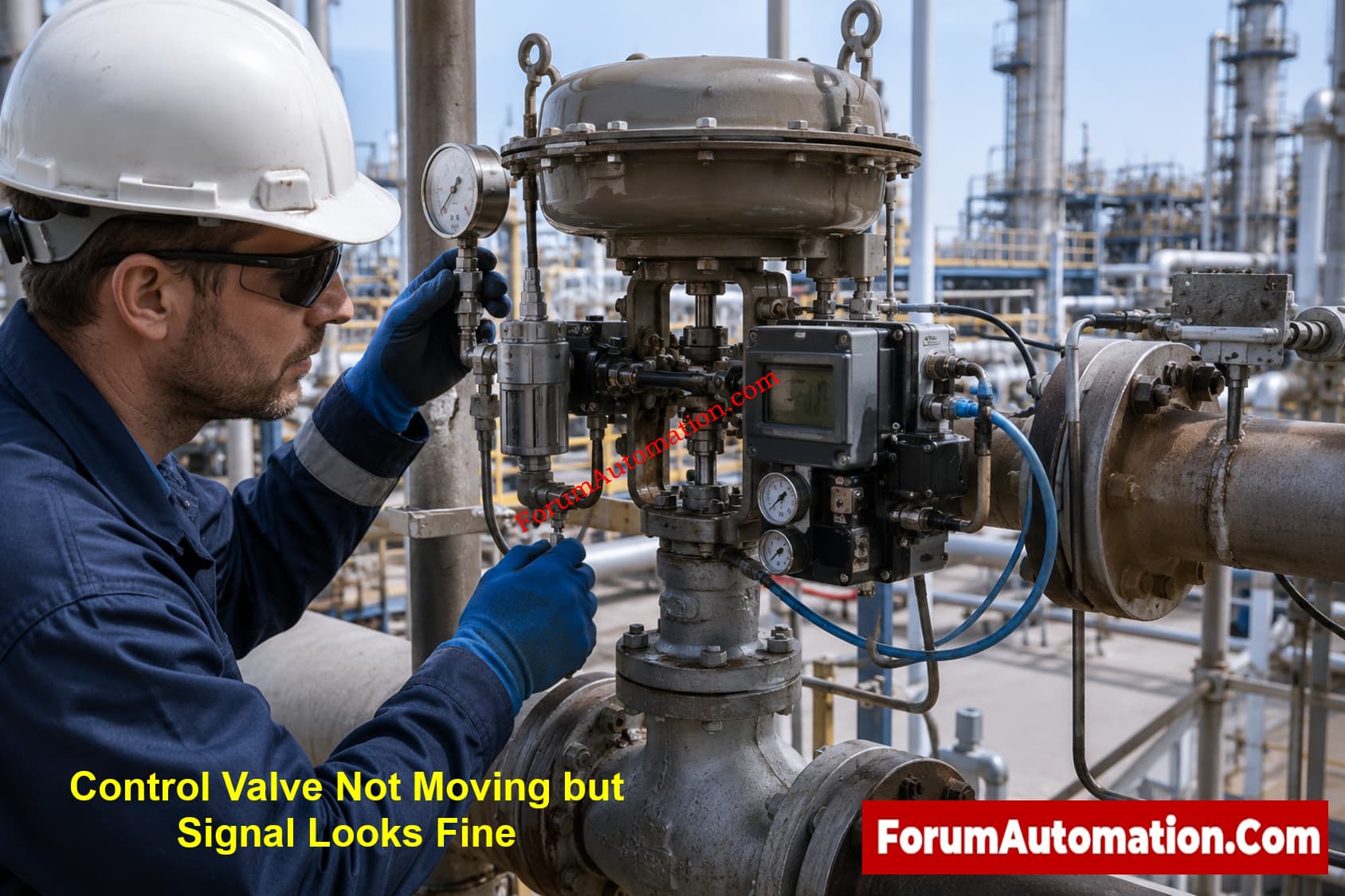
Control Valve Not Moving but Signal Looks Fine
We have a flow control valve that is causing some trouble. The DCS output is steady at around 55%, and when we checked in the field, the I/P converter is receiving the correct 4–20 mA signal. Instrument air pressure is also healthy. However, the valve hardly moves and the process flow is not responding. There are no active alarms, and the valve was working perfectly during the previous shift. Before we start replacing components, what would be your troubleshooting approach? Could this be an actuator issue, positioner problem, or something else?
Control Valve Not Moving but Signal Looks Fine
If a control valve is not responding, but the DCS output is steady at 55% and the I/P converter is receiving the right 4-20 mA signal and has healthy instrument air pressure, a methodical troubleshooting strategy should be taken before changing any components.
Step 1: Verify Valve Position Feedback
First compare the actual valve position to the commanded position. A mismatch tends to imply a positioner, actuator or mechanical problem rather than a control signal problem.
Step 2: Check Positioner Operation
Observe if the output pressure of the valve positioner varies as the control signal changes. Actuator may not move even with correct input signal due to malfunctioning positioner relay, clogged nozzle, obstructed pneumatic route or calibration issue.
Step 3: Inspect Actuator Performance
Check actuator diaphragm integrity, spring quality, piston seals and air leaks. A ruptured diaphragm or a broken seal could result in the actuator not being able to generate enough thrust to move the valve stem.
Step 4: Examine Mechanical Components
Check valve stem, linkage, coupling, yoke and packing assembly. Valve sticking in position due to packing friction, corrosion, debris build-up or mechanical binding.
Step 5: Perform a Manual Stroke Test
If process conditions allow, hand stroke the valve from the positioner or local handwheel. This helps to evaluate whether the problem is pneumatic, mechanical or process related.
Common Root Causes
- Valve stem sticking
- Failure of positioner
- Air passageways blocked
- Actuator diaphragm damaged
- High friction on packing
- Linkage Failure (Mechanical)
The defect is generally immediately identified by a structured signal-air-actuator-mechanical inspection sequence, thus avoiding wasteful component replacement.