Capacitor Bank vs Reactor: What is the Difference?
Capacitor banks and reactors are essential components in electrical power systems, but they perform opposite functions.
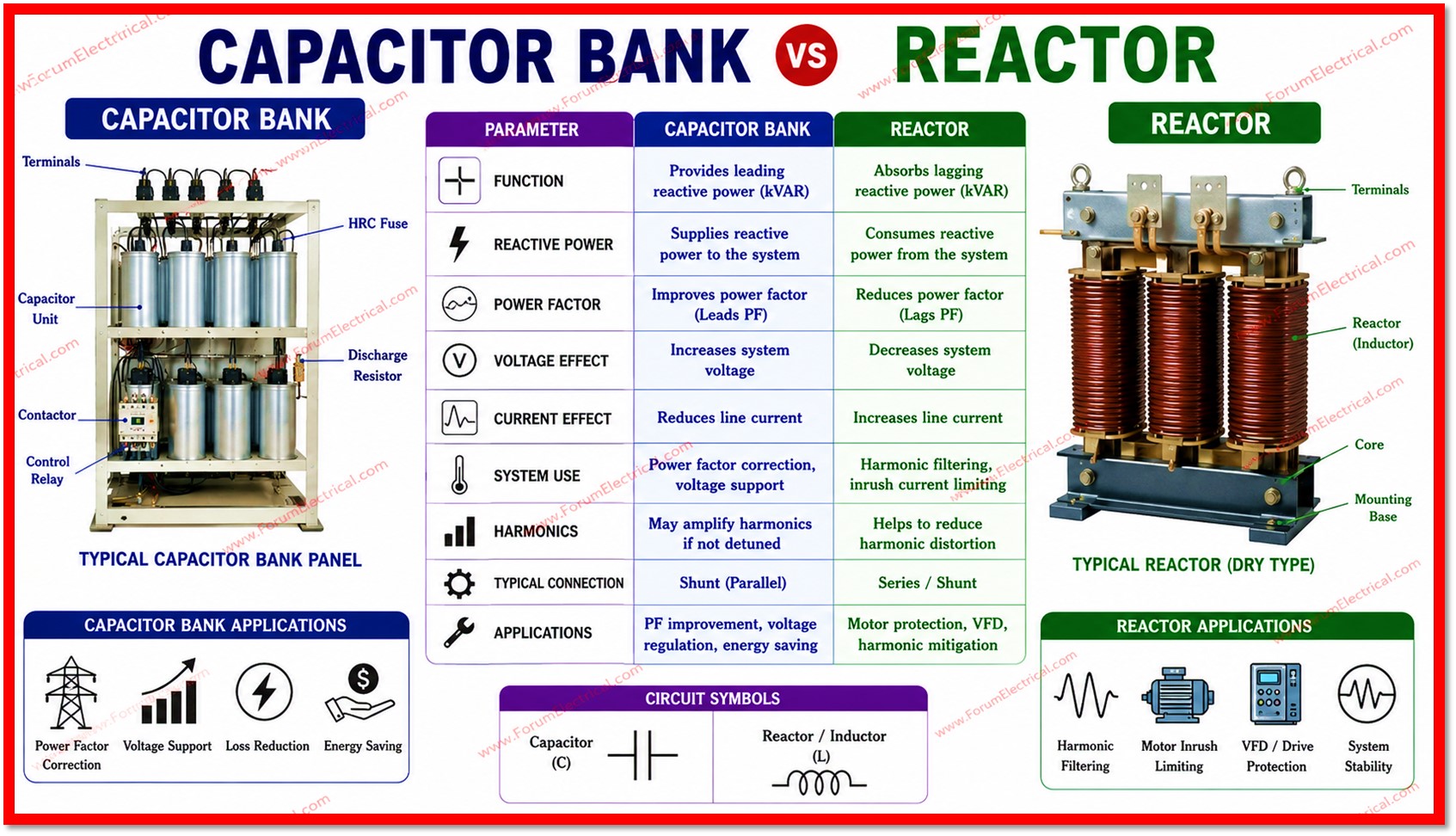
A capacitor bank supplies reactive power to improve power factor and support voltage, whereas a reactor absorbs reactive power to control voltage, limit fault current, and suppress harmonics.
Choosing the right device depends on the specific requirements of the power system.
Capacitor Bank
A capacitor bank consists of multiple capacitors connected together to provide capacitive reactive power (kVAR). It improves power factor, reduces transmission losses, enhances voltage stability, and lowers electricity costs by minimizing reactive power demand.
Reactor
A reactor is an inductive device that consumes reactive power. It is used to limit short-circuit current, control overvoltage, reduce switching surges, and filter harmonics in transmission, distribution, and industrial electrical systems.
Difference between Capacitor Bank and Reactor
Capacitor Bank vs Reactor
| Parameter | Capacitor Bank | Reactor |
|---|---|---|
| Primary Function | Supplies reactive power | Absorbs reactive power |
| Component Type | Capacitive | Inductive |
| Power Factor | Improves lagging power factor | Controls leading power factor |
| Voltage Effect | Raises system voltage | Reduces system voltage |
| Current Effect | Increases capacitive current | Limits excessive current |
| Harmonic Control | May amplify harmonics if not filtered | Helps suppress harmonics |
| Fault Current | Does not limit fault current | Limits short-circuit current |
| Common Applications | APFC panels, substations, industrial plants | Harmonic filters, transmission systems, current limiting, capacitor bank protection |
| Reactive Power | Generates kVAR | Consumes kVAR |
| Main Benefit | Improved efficiency and reduced penalties | Enhanced system protection and voltage control |
Conclusion
Capacitor banks and reactors complement each other in modern power systems. While capacitor banks improve power factor and voltage by supplying reactive power, reactors provide system stability by absorbing reactive power, limiting fault currents, and reducing harmonics. Together, they ensure efficient, reliable, and safe operation of electrical networks.