Capacitance Level Transmitter Shows Unstable Level Despite a Constant Process Level
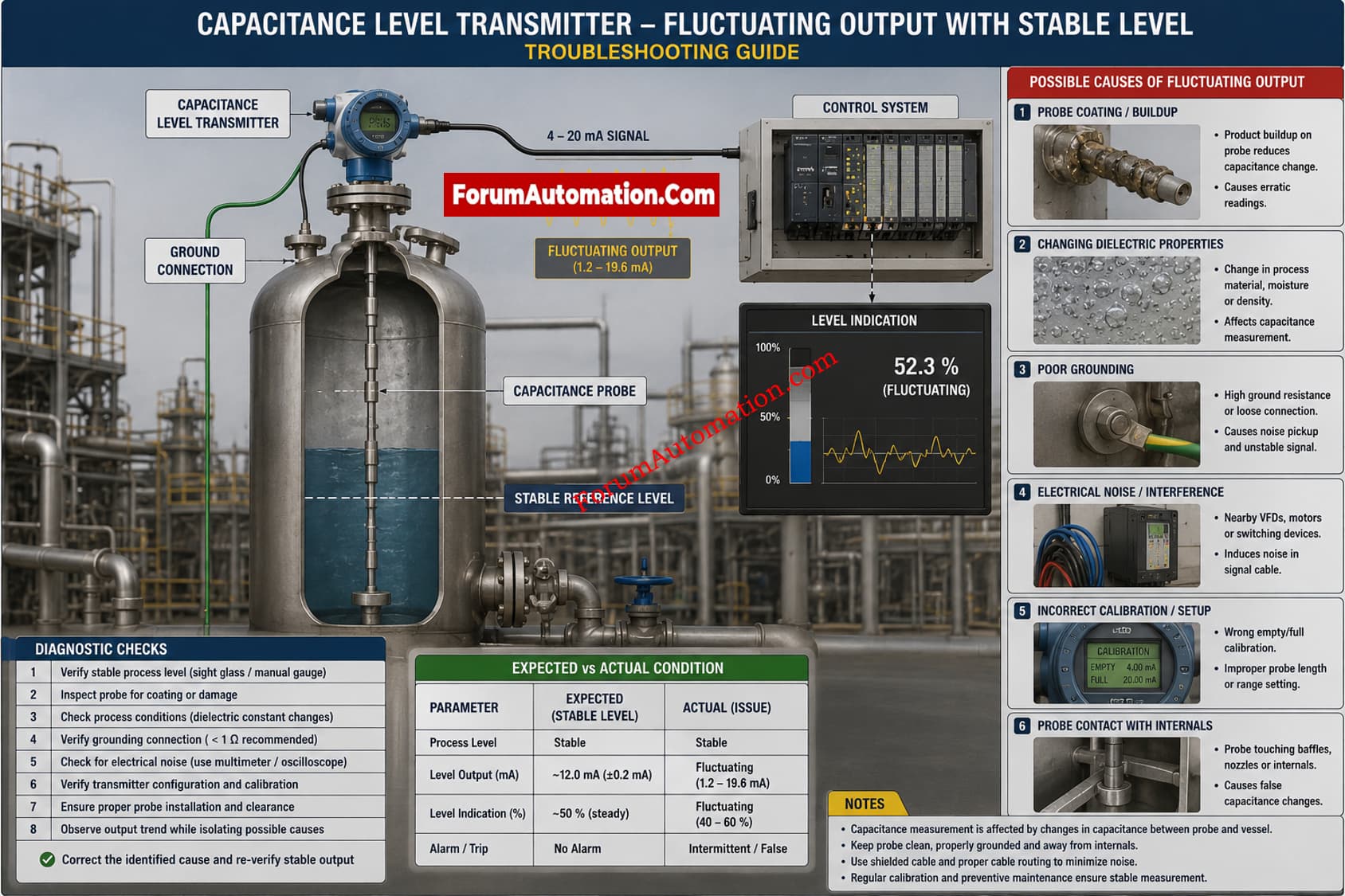
A capacitance level transmitter monitors variations in capacitance between the sensing probe and the vessel or reference electrode. Thus, the output can be unstable even if the real process level is steady. Any unwarranted change in the electrical or process conditions hence may show up as a level change.
First, see if material is piling up on the capacitance probe. The effective capacitance can be changed by coating, moisture, sticky process material or deposits, causing variable values. The dielectric constant of the process material must also be validated as variations in the material composition, density, moisture or phase can influence the measurement.
Another key topic to check is grounding. Poor vessel grounding, inadequate probe reference, or electrical noise may cause capacitance measurement instability. Check transmitter ground, shield connection, cable condition and supply power.
The installation of the probe should also be checked. Ensure that the probe does not touch the wall of the vessel, the internal agitator, the heating coil or other conductive parts. Unstable signal can also be caused by mechanical movement or vibration.
Then, check the transmitter configuration and calibration. Check empty and full calibration point, probe length, dielectric constant settings, measurement range, damping and sensitivity setup.
If the transmitter has a simulation or diagnostic function, compare the real output with the simulated output. Also examine the 4 to 20mA loop for electrical noise or loose connections.
Likely causes are probe coating, changing dielectric characteristics, weak ground, wrong calibration, electrical noise or inappropriate installation of the probe.