Selecting the right cable insulation is not just a specification exercise and it directly impacts safety, reliability, fire performance and lifecycle cost.
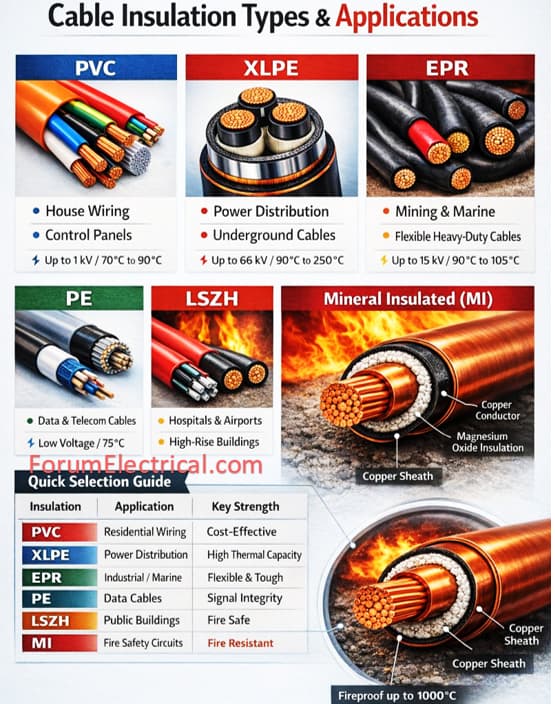
PVC (Polyvinyl Chloride)
Common in residential & LV distribution
Economical & moisture resistant
70–90°C rating
Used for: House wiring, control panels, small power circuits
Not suitable for high temperature or harsh chemical zones
XLPE (Cross-Linked Polyethylene)
90°C normal / 250°C short circuit
High dielectric strength
Low losses & high current carrying capacity
Used for: LV, MV, HV feeders, underground cables, substations, solar DC
Today’s standard for modern power distribution.
EPR (Ethylene Propylene Rubber)
Flexible & moisture resistant
90–105°C rating
High mechanical durability
Used for: Mining, marine, heavy-duty industrial trailing cables
PE (Polyethylene)
Excellent dielectric properties
Low capacitance
Used for: Telecom, coaxial, data cables
LSZH (Low Smoke Zero Halogen)
Emits minimal smoke
No toxic halogen gases during fire
Used for: Hospitals, airports, metros, data centers, high-rise buildings
Essential for life safety compliance.
Mineral Insulated (MI) Cable (Copper Sheathed)
This is where fire survival is non-negotiable.
Copper conductor
Magnesium oxide (MgO) insulation
Copper sheath
Fire resistant up to ~1000°C
Completely inorganic construction
Why MI Cable is Important?
• Maintains circuit integrity during fire
• Zero smoke & zero toxic gas
• Extremely long service life
• Highly resistant to moisture and mechanical damage
Used for:
• Fire alarm systems
• Emergency lighting circuits
• Fire pumps
• Critical hospital power supply
• Oil & gas hazardous zones
• Nuclear & high-temperature environments
Cable insulation must be selected based on:
• Voltage level
• Ambient temperature
• Installation method
• Short circuit rating
• Fire survival requirement
• Chemical & moisture exposure
• Regulatory compliance
Incorrect selection can lead to premature failure, safety risks and compliance issues.