Electrical Relays
-
Relay Relay protects electrical systems by detecting faults and tripping circuit breakers.
-
Working Principle Operates during abnormal conditions like overloads or short circuits.
-
Types of Relays
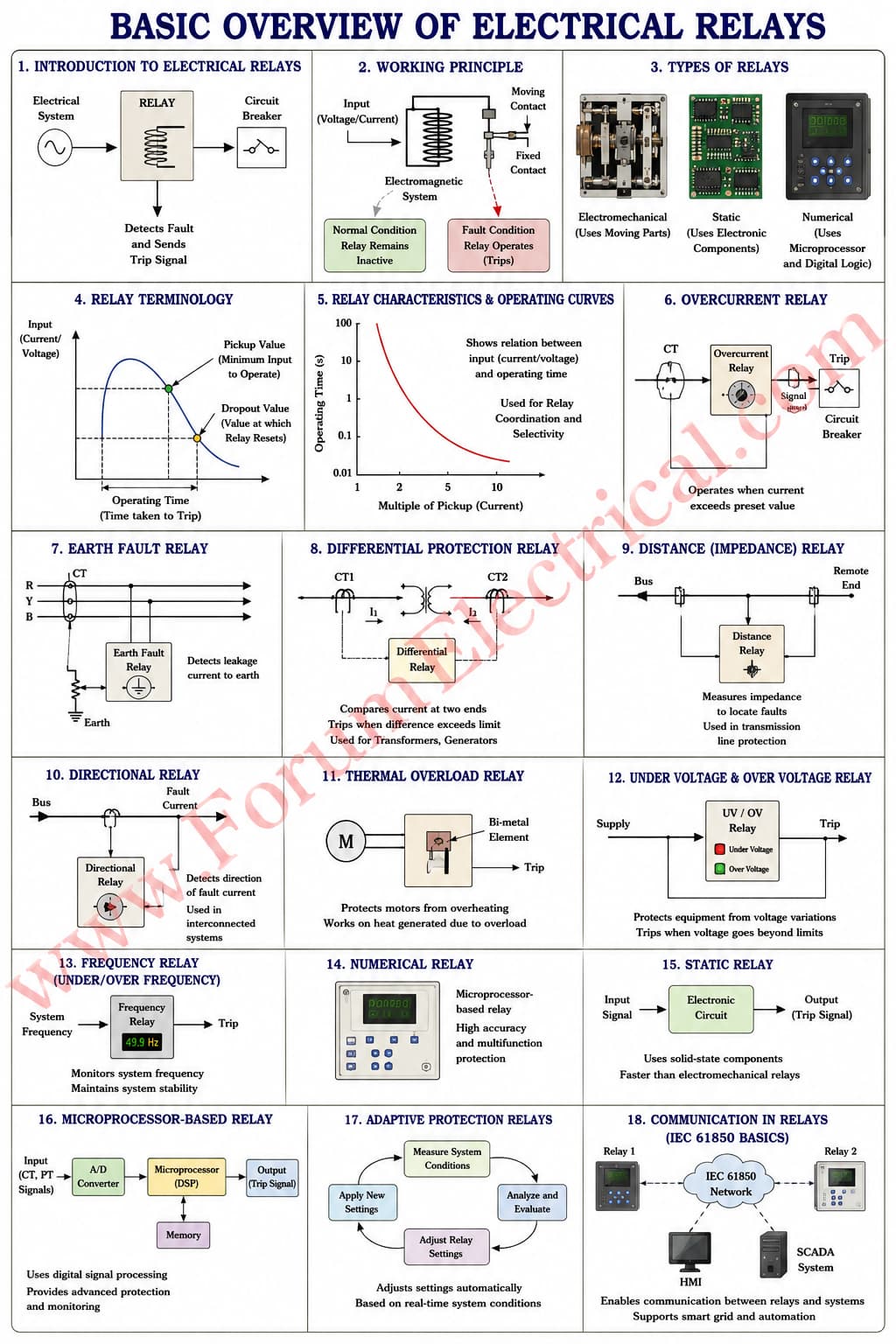
Electromechanical, Static and Numerical
- Relay Terms
Pickup Value
Dropout Value
Operating Time
-
Relay Characteristics Shows operating time based on fault current or voltage.
-
Overcurrent Relay Trips when current exceeds the set limit.
-
Earth Fault Relay Detects leakage current to earth.
-
Differential Relay Compares currents at both ends of equipment.
-
Distance Relay Measures impedance to detect transmission line faults.
-
Directional Relay Detects fault current direction.
-
Thermal Overload Relay Protects motors from overheating.
-
Voltage Relay Protects against overvoltage and undervoltage.
-
Frequency Relay Monitors under and over frequency conditions.
-
Numerical Relay Digital relay with multifunction protection.
-
Static Relay Electronic relay with fast operation.
-
Microprocessor Relay Uses digital processing for advanced protection.
-
Adaptive Relay Automatically changes settings based on system conditions.
-
IEC 61850 Communication Enables relay communication and substation automation.