ANSI/IEEE Relay Function Numbers in Power System Protection
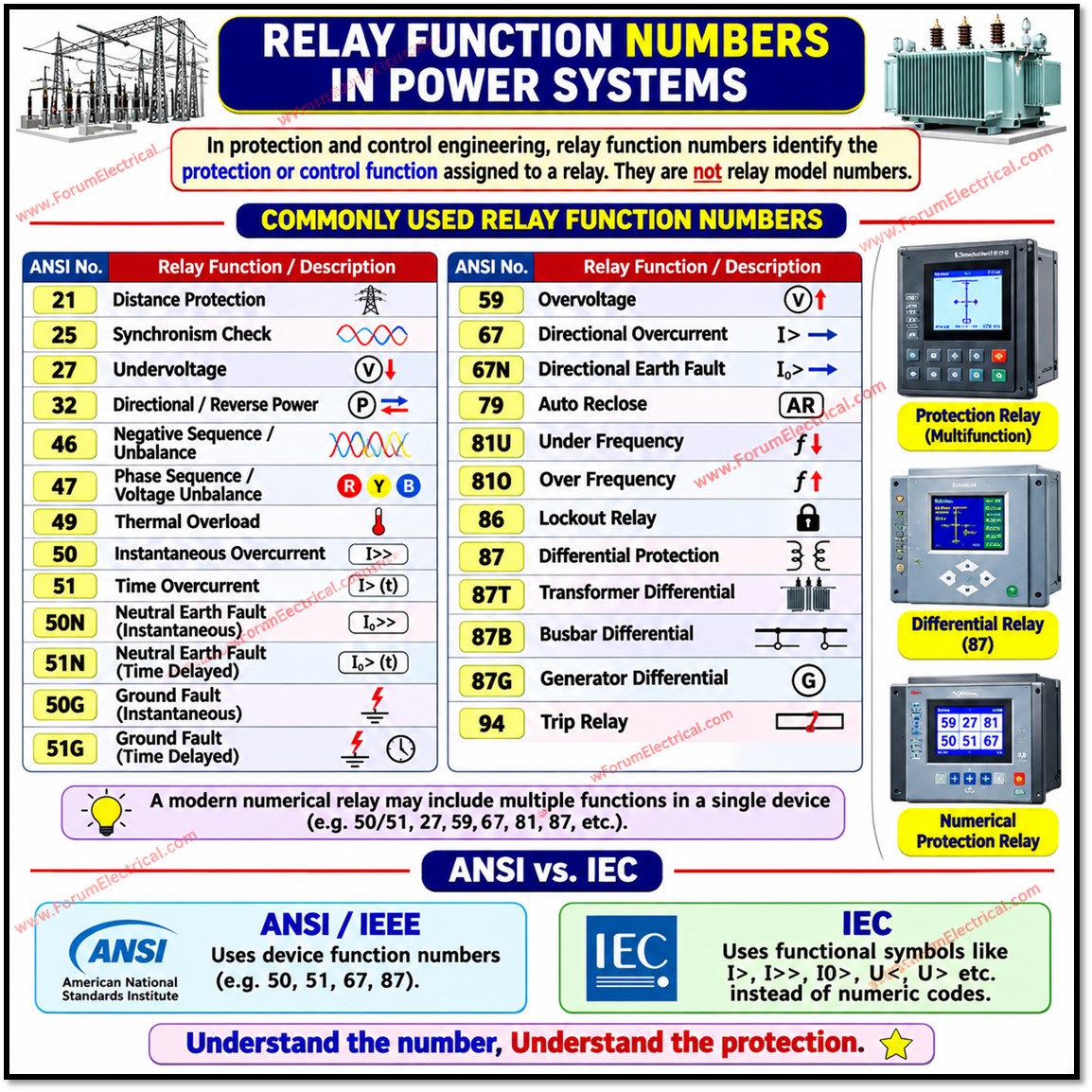
ANSI/IEEE device function numbers are standardized identifiers used in electrical protection, control, and automation systems to specify the operating functions of protective relays. These numbers are commonly referenced in substation single-line diagrams (SLDs), protection schemes, relay configuration files, control logic diagrams, and commissioning documents.
Common Protective Relay Function Numbers
- 21 – Distance Protection
- 25 – Synchronism-Check Relay
- 27 – Undervoltage Protection
- 32 – Directional Power / Reverse Power Protection
- 46 – Negative-Sequence Overcurrent Protection
- 47 – Phase-Sequence or Phase-Voltage Unbalance Protection
- 49 – Thermal Overload Protection
- 50 – Instantaneous Overcurrent Protection
- 51 – Time-Delayed Overcurrent Protection
- 50N/51N – Neutral Overcurrent / Earth-Fault Protection
- 50G/51G – Ground-Fault Overcurrent Protection
- 59 – Overvoltage Protection
- 67 – Directional Overcurrent Protection
- 67N – Directional Earth-Fault Protection
- 79 – Automatic Reclosing
- 81U/81O – Underfrequency / Overfrequency Protection
- 86 – Lockout Relay
- 87 – Differential Protection
- 94 – Tripping Relay
Application in Numerical Protection Relays
Modern numerical protection relays integrate multiple protection functions into a single hardware platform. For example, a feeder protection relay may incorporate 50/51, 50N/51N, 27, 59, and 67 functions, depending on the protection philosophy and relay configuration.
ANSI/IEEE vs IEC Protection Identification
ANSI/IEEE standards use device function numbers to identify protection and control functions. IEC standards commonly use functional designations and standardized graphical or alphanumeric symbols, such as I>, I>>, U, depending on the applicable IEC standard and manufacturer documentation.
Understanding relay function numbers is essential for protection engineers, substation commissioning engineers, electrical maintenance personnel, and power system professionals. These identifiers help determine the measured electrical parameters, fault detection criteria, protection operating characteristics, and associated tripping or control actions.